

close
Choose Your Site
Global
Social Media
Views: 0 Author: Site Editor Publish Time: 2026-04-29 Origin: Site


Building a custom enclosure for applying dry finishes demands far more than basic woodworking skills. It represents a critical engineering challenge focused on precise fluid dynamics, static control, and rigorous combustible dust management. Many operators treat this construction process lightly. They quickly face severe consequences. An improperly built enclosure inevitably leads to inconsistent surface finishes, soaring rework costs, and massive safety liabilities.
You cannot afford to guess when operator safety and product quality hang in the balance. We must establish a strict baseline for bottom-of-funnel decision-makers. Whether you design a compact 1m² desktop setup or a massive walk-in enclosure, aligning your custom build with industrial standards remains non-negotiable. Proper alignment guarantees operational success. In this guide, you will learn the exact engineering principles, compliance rules, and structural guidelines required to succeed.
Compliance is paramount: Custom setups must aim to mirror NFPA 33 and OSHA standards, specifically keeping powder concentration below 50% of the Lower Explosive Limit (LEL).
Material selection dictates lifespan: Avoid cheap hot-rolled steel that rusts; opt for galvanized steel, stainless steel, or 20x20 aluminum extrusions for lightweight framing.
Airflow beats extraction power: Doubling fan size isn't always the answer. Designing proper cross-draft or downdraft systems—and running fans coupled in series—often yields better overspray control.
Integration matters: A booth is just one node in a complete powder coating line; isolation from the curing oven and static-grounding systems are critical for ROI.
Every successful Powder Coating Booth must achieve three primary objectives. It must deliver 100% overspray containment. It must guarantee zero cross-contamination between color changes. Finally, it must ensure total operator safety. Achieving these goals requires careful planning. We must weigh the true Total Cost of Ownership (TCO) before deciding whether to purchase a pre-fabricated unit or build a custom solution.
The trade-off between pre-fabricated and custom setups involves more than just upfront material costs. Pre-fabricated modular units demand higher upfront capital expenditure (CapEx). However, they provide guaranteed Cubic Feet per Minute (CFM) ratings, robust warranties, and immediate compliance documentation. You plug them in and start working securely. Custom builds appear cheaper initially. Yet, they carry hidden costs. You will spend countless labor hours balancing airflow through trial and error. You also risk rendering your facility uninsurable if you ignore critical safety standards.
Use this decision framework to guide your choice. Shortlist a custom build only if your spatial constraints are highly unique. Custom builds also make sense if you need a specialized prototype for small batch testing. Once your throughput scales, investing in commercial units becomes mandatory.
Evaluation Criteria | Pre-Fabricated / Modular Booths | Custom / DIY Builds |
|---|---|---|
Initial Cost (CapEx) | High upfront investment. | Low initial material costs. |
Total Cost of Ownership | Predictable maintenance, minimal downtime. | High hidden costs in labor, testing, and balancing. |
Safety & Compliance | Pre-certified for NFPA and OSHA standards. | Requires rigorous self-auditing and potential uninsurability risks. |
Best Use Case | High-volume production and commercial scaling. | Unique spatial limits, desktop setups, or prototype testing. |
Industrial safety rules exist to prevent catastrophic accidents. Your custom enclosure is effectively a controlled containment zone for explosive particulates. We must manage combustible dust aggressively. NFPA 33 standards dictate specific airflow requirements. You must keep the powder-to-air ratio strictly under 50% of the Lower Explosive Limit (LEL). Exceeding this limit turns your workspace into a highly volatile environment. Proper exhaust ventilation pulls suspended particles away before they concentrate dangerously.
Static dissipation serves as the second pillar of safe operation. Mandatory requirements demand an anti-static, properly grounded floor. Powder application relies on electrostatic charges to adhere the material to the workpiece. Without absolute grounding, transfer efficiency drops dramatically. The powder simply repels off the part. More importantly, ungrounded environments invite severe static-ignition spikes. A single static discharge can ignite suspended airborne dust instantly.
You must also integrate interlocking control systems. Industrial standards require these fail-safes. An interlocking system monitors your exhaust fans. If a fan fails or airflow drops, the system automatically shuts down the compressed air supply. It also cuts power to the spray guns. This prevents operators from continuing to spray material into a stagnant, unventilated space.
Finally, we must address the operator Personal Protective Equipment (PPE) baseline. Standard paper dust masks are entirely insufficient. Specialized particulates bypass basic filters easily. Operators must wear Assigned Protection Factor (APF) 20+ rated respirators. Strict adherence to this PPE baseline prevents severe long-term respiratory damage.
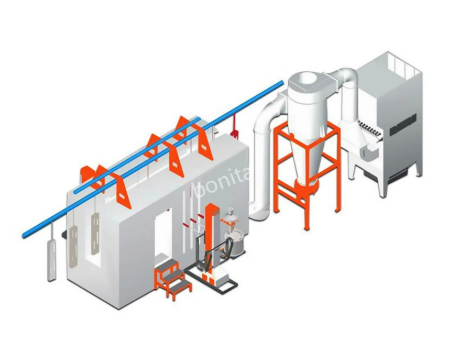
Designing a functional system requires selecting the right physical components. The enclosure provides structural integrity. Batch setups typically utilize open-face or fully enclosed profiles. Open-face designs work well for rapid part loading. Fully enclosed designs offer superior contamination control for high-precision finishes. Regardless of the profile, avoid combustible materials. We recommend using 22-gauge galvanized steel. Flame-retardant curtains also work well to prevent the structure from becoming a fire hazard.
Airflow architecture dictates how effectively you capture overspray. You must evaluate two primary directions:
Downdraft Systems: These pull air down through a grated floor. They are ideal for large, heavy parts. Gravity assists the airflow, pulling heavy particulates down rapidly.
Cross-draft Systems: These pull air horizontally away from the operator toward a rear filter bank. They suit smaller parts and batch operations perfectly.
Filtration and powder recovery systems handle the captured overspray. Simple exhaust setups use HEPA or cartridge filters. These work best for spray-to-waste operations where you discard the overspray. High-volume operations require cyclone separators. Cyclones spin the air, dropping heavy powder into a collection bin for reclamation. This reclaims expensive material and reduces waste.
Illumination directly impacts finish quality. Operators need clear visibility to gauge powder film thickness during application. You must install shadowless, explosion-proof LED lighting. Standard light fixtures pose a severe ignition risk. Dust can infiltrate standard housings and ignite on hot bulbs. Explosion-proof housings seal the electrical components entirely away from the hazardous environment.
Translating blueprints into physical structures reveals numerous hidden challenges. We consistently see builders make the same critical errors. Follow these steps to navigate common pitfalls successfully.
Structural Framing & Skinning: A major risk factor involves using hot-rolled low-carbon steel for the frame or skin. Builders choose it for its low price. The outcome is disastrous. Hot-rolled steel rusts rapidly over time. Flakes of rust will detach and contaminate your fresh powder finishes. The solution requires using 22-gauge galvanized or stainless steel. If you are building a light-duty or desktop setup, use 20x20 aluminum extrusions. Pair them with smooth hardboard or metal sheets. This offers a modular, easily adaptable skeleton.
Optimizing Exhaust Pressure: Many builders struggle with inadequate suction. A single-fan setup often lacks enough static pressure to pull air through thick, loaded filters. Adding a larger fan rarely solves this issue efficiently. The tactical fix involves the series method. You couple two robust fans—such as 20-inch high-CFM units—in series. Placing one fan directly behind the other doubles the extraction force. This pushes air through dense filtration media without expanding the physical footprint of your exhaust plenum.
Workpiece Handling & Dead Zones: Uneven coating plagues many custom setups. Operators often struggle to reach the back of a part. They compensate by rotating themselves and spraying outward toward the open room. This defeats the containment system entirely. Mitigate this risk by integrating a heavy-duty grounded rotational base. A metal "lazy susan" works perfectly for batch operations. The operator remains stationary, spraying safely into the airflow, while the part rotates smoothly.
Your enclosure does not operate in isolation. It functions as a critical node within a larger production ecosystem. Proper integration dictates your overall throughput and finish quality. You must map out the spatial workflow carefully. Calculate the physical distance required between the spray zone and the curing oven. Placing them too close invites disaster. Ambient factory air can blow dust onto uncured parts. Worse, heat creep from the curing oven can partially melt powder on the gun tip or pre-cure parts prematurely. Maintain strict physical separation.
Material handling and rack systems require strict discipline. We enforce one critical rule above all others. Internal hanging racks and conveyor hooks must never be made of pre-powder-coated or painted materials. High oven temperatures degrade existing finishes quickly. Old coatings will blister, flake off, and fall directly onto your freshly sprayed workpieces. Always use bare metal or chrome-plated steel for all hanging fixtures. Furthermore, you must clean these hooks regularly to maintain proper electrical grounding.
Eventually, manual batch operations hit a ceiling. Throughput volume will exceed your manual capacity. Transitioning to a fully automated powder coating line becomes the logical next step. Scaling up requires moving from cross-draft batch designs to pass-through conveyor enclosures. You will need automated gun movers, advanced cyclone recovery systems, and integrated infrared pre-heating zones. Planning your factory floor layout early ensures you have the physical space to implement this automated conveyor track later.
Building an effective containment system requires rigorous adherence to industrial fluid dynamics and fire safety standards. You cannot treat this process as a weekend garage project. While clever sourcing minimizes framing material costs, you must never compromise on core engineering. Skimping on filtration, grounding systems, or LEL management entirely negates any return on investment gained from a DIY build. Poor finishes and safety hazards will cost you more than a commercial unit.
Your next step requires immediate action. Audit your available floor space carefully. Measure your intended enclosure dimensions. Calculate your required CFM based on the total booth volume and desired face velocity. Finally, price out compliant explosion-proof exhaust fans and multi-stage filtration components. Compare this custom Bill of Materials against pre-fabricated options before finalizing your build-or-buy decision.
A: You calculate required CFM based on the open face area of the enclosure. Measure the width and height of the opening in feet. Multiply them to get the square footage. Industrial standards require maintaining a minimum face velocity of 100 feet per minute (FPM). Multiply your square footage by 100. This provides the baseline CFM needed to capture overspray effectively.
A: No. Wood and drywall present severe fire risks in combustible dust environments. They also generate massive static cling, causing powder to stick aggressively to the walls. NFPA standards strictly require using smooth, non-combustible surfaces. Always use grounded materials like galvanized steel or stainless steel to ensure safety and allow for easy cleaning.
A: Implement a strict micro-SOP. Perform daily vacuuming using only an explosion-proof industrial vacuum. Wipe down all rubber seals and door jambs daily. Weekly, monitor your filter pressure drops using a built-in manometer to know exactly when to replace cartridges. Never use compressed air to blow down the walls, as this creates explosive dust clouds.


