

close
Choose Your Site
Global
Social Media
Views: 0 Author: Site Editor Publish Time: 2026-04-30 Origin: Site


Transitioning from liquid paint to a modern dry-powder system represents a major operational shift. Manufacturers everywhere face immense pressure to deliver tougher finishes while cutting environmental waste. Modern Powder Coating Equipment solves these problems efficiently. It applies a strong electrostatic charge to dry polymer resins. It then adheres these resins securely to grounded substrates before heat-curing them into a highly durable, cross-linked finish.
Traditional liquid applications struggle to match this long-lasting durability. They also generate high VOC emissions and excessive overspray waste. Upgrading to advanced dry systems eliminates VOCs completely. It also significantly boosts impact and chemical resistance. In this guide, you will learn how to configure a full finishing setup. We will explore how to select the correct application hardware and evaluate the total cost of ownership. You will also discover crucial safety protocols to guarantee efficient, high-quality production.
A complete powder coating line requires three distinct equipment phases: mechanical/chemical pretreatment, electrostatic application, and thermal curing.
Equipment selection dictates throughput: Batch systems serve low-volume, high-mix operations, while automated lines support standardized, continuous production.
Advanced application hardware (e.g., Tribo guns) and environmental controls directly impact Total Cost of Ownership (TCO) by mitigating the "Faraday cage effect" and enabling up to 95% powder recovery.
Safe and efficient implementation requires strict adherence to substrate grounding protocols and precise thermal management (typically 325°F to 450°F).

Building a reliable powder coating line involves precise engineering. You cannot simply spray powder onto a raw part and expect it to stick. The process demands three strict operational phases. Each phase relies on specialized industrial machinery designed for exact tolerances.
Surface preparation dictates the final lifespan of your coating. Contaminants like grease, rust, or mill scale will cause premature coating failure. We typically divide pretreatment into two distinct methodologies: mechanical and chemical.
Mechanical Pretreatment: Many industrial operations utilize heavy-duty blast rooms. These enclosures blast abrasive media—such as steel grit or aluminum oxide—against the metal surface. This action strips away scale, rust, and old paint. Industry standards like SSPC-SP 5 (White Metal Blast) or SSPC-SP 10 (Near-White Metal Blast) dictate the required cleanliness levels. Proper blasting creates a microscopic anchor profile. This texture helps the powder bite into the metal.
Chemical Pretreatment: Lighter or more delicate parts often run through multi-stage wash stations. These systems spray heated chemicals to cleanse the substrate. A standard multi-stage process includes:
Alkaline degreasers to remove cutting oils and shop dirt.
Clean water rinses to neutralize the surface.
Iron phosphates or etching agents to create a conversion coating.
Final dry-off ovens running at high temperatures. These ovens ensure zero moisture retention before the parts enter the spray booth.
Once parts exit the pretreatment phase, they move into the application zone. Containment spray booths serve as the heart of this step. Engineers design these booths to maintain strict negative pressure. They pull clean airflow across the operator and over the parts. This airflow safely controls overspray and prevents airborne particles from contaminating the wider factory floor.
Recovery modules form the second half of the application hardware. They capture powder particles missing the target substrate. Manufacturers integrate either cyclone separators or high-efficiency cartridge filters. Cyclone separators spin the air rapidly to drop heavy powder particles into a collection hopper. You can then reclaim and reuse this single-color powder, drastically lowering material waste.
The final phase involves thermal curing. Parts enter massive industrial ovens to bake. Convection ovens remain the most popular choice. They run on gas or electric power and operate steadily between 325°F and 450°F. The ambient heat causes the dry powder to melt, flow out evenly, and chemically cross-link into a solid shell.
Some modern operations employ Infrared (IR) or hybrid ovens. IR panels emit radiation directly into the substrate surface. This method creates rapid, targeted heating. It reduces overall cycle times and shrinks the required factory floor space.
Best Practices for Core Components
Daily Maintenance: Clean wash station nozzles daily to prevent chemical clogs.
Air Quality: Ensure compressed air feeding the spray guns runs through a refrigerated dryer. Moisture in the air lines will ruin the powder finish.
Selecting the correct spray gun technology directly impacts your coating quality. Different part geometries require different electrostatic charging methods. We typically evaluate three primary application technologies.
Corona charging represents the industry standard. A Corona gun actively generates a high-voltage electrostatic field right at the gun tip. As powder passes through this field, the particles pick up a strong negative charge. They then fly toward the grounded, positively charged substrate.
This technology works best for standard flat applications, varying coating thicknesses, and metallic finishes. However, Corona systems face a major limitation. They suffer from the "Faraday cage effect." When spraying deep recesses, tight corners, or complex geometries, the high-voltage field pushes powder away from the internal cavity. The charge accumulates on the outer edges instead.
Tribo charging systems solve the Faraday cage problem. These guns omit the high-voltage cascade generator completely. Instead, they rely purely on friction. The gun barrel contains specialized Teflon tubes. As compressed air forces the powder rapidly through these tubes, the friction generates a static electrical charge.
Tribo guns lack a dominating electrical field at the tip. Therefore, they push powder effortlessly into tight corners and deep channels. They work perfectly for highly complex parts and exceptionally smooth surface requirements. You avoid the heavy edge-build commonly seen in Corona applications.
Fluidized bed systems bypass spray guns entirely. Operators pre-heat the metal parts in an oven. They then submerge these hot parts directly into a large hopper. This hopper contains aerated, suspended powder. The powder immediately melts and adheres upon contact with the hot metal.
We recommend fluidized beds for thick, functional coatings. They excel at coating items like industrial valves, heavy-duty wire racks, and electrical busbars.
Table: Application Technology Comparison
Technology Type | Charging Mechanism | Ideal Use Cases | Primary Limitation |
|---|---|---|---|
Corona System | High-voltage electrical field at gun tip | Standard flat panels, metallic powders, rapid coverage | Faraday cage effect in tight inside corners |
Tribo System | Friction within Teflon-lined gun barrel | Complex geometries, deep recesses, smooth finishes | Slower application speed, requires specific powder blends |
Fluidized Bed | Thermal melting via dipping pre-heated parts | Thick functional coatings, wire racks, valves | Incapable of applying very thin or highly decorative films |
Your production volume and part variety will dictate your system architecture. Facilities must choose between batch processing and fully automated conveyor layouts.
Batch systems rely on manual part transfer. Operators hang parts on rolling racks or standalone hoists. They manually push these racks from the wash station, into the spray booth, and finally into the curing oven.
This layout fits custom job shops perfectly. It handles large or heavy industrial components well. If your operation requires frequent color changeovers throughout the day, a batch system offers immense flexibility. Furthermore, batch setups require a lower initial capital expenditure and occupy a much smaller factory footprint.
Automated systems utilize continuous-speed overhead or floor-mounted conveyors. These lines carry parts seamlessly through all three production stages without manual intervention. Operators simply load raw parts at the start and unload finished parts at the end.
Automated layouts fit high-volume, standardized OEM production runs. They require a very high upfront integration cost. They also demand significant continuous floor space. However, they yield the lowest per-part labor cost. An automated line maximizes throughput and guarantees extreme consistency across thousands of parts.
Common Mistakes in Layout Planning
Ignoring cool-down zones: Parts exit the oven at 400°F. Automated lines must include enough conveyor track length for parts to cool before operators handle them.
Underestimating ceiling height: Large convection ovens require massive exhaust stacks and elevated heating units. Always measure overhead clearances carefully.
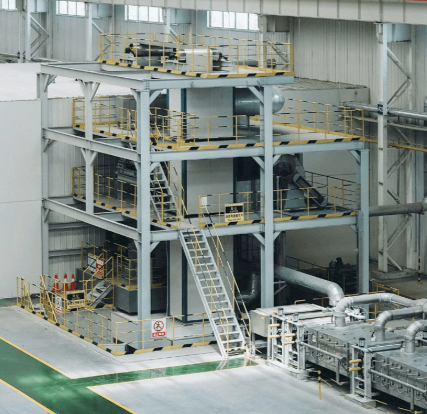
Evaluating your return on investment requires looking beyond the initial equipment sticker price. Material utilization and energy consumption dominate your long-term operating costs.
Traditional liquid painting wastes up to 50% of the material through overspray. Powder systems flip this metric. Advanced reclaim systems capture and reuse powder continuously. They can push your overall transfer efficiency to 95%. This drastically lowers consumable costs over time.
However, reclaim systems require rigorous maintenance. If you run multiple colors through the same cyclone separator, you must clean it thoroughly. Even a few grams of blue powder left behind will cross-contaminate a subsequent batch of white powder, ruining the entire production run.
Curing is the most energy-intensive phase of any finishing operation. Ovens burn massive amounts of natural gas or electricity. Upgrading to advanced oven insulation packages directly reduces your baseline power draw. Some manufacturers also integrate special Energy Efficiency Packs (EEP) to recycle heated exhaust air.
Formulators now produce low-temperature powders. These specialized mixtures melt and cross-link at 265°F to 285°F. Dropping oven temperatures saves significant energy. However, it introduces a critical TCO trade-off. Low-temperature powders react easily to ambient heat. You must store them in refrigerated, climate-controlled rooms. The cost of running this cold-chain storage sometimes negates the oven energy savings.
Chart: Typical Total Cost of Ownership (TCO) Distribution
Cost Category | Estimated % of 5-Year TCO | Primary Cost Driver |
|---|---|---|
Energy (Gas/Electric) | 40% | Curing oven operation and heated wash stages |
Consumables (Powder/Chemicals) | 30% | Transfer efficiency rates and powder recovery utilization |
Labor & Maintenance | 20% | Manual spraying, part loading, filter replacements |
Capital Equipment Amortization | 10% | Initial purchase of booths, ovens, and conveyors |
Deploying heavy industrial equipment introduces safety hazards and quality control challenges. You must implement strict operational protocols from day one.
Proper grounding dictates the success of electrostatic application. Your metal parts, conveyor hooks, and operators must connect perfectly to an earth ground. Failure to properly ground parts results in severe consequences.
First, poor grounding ruins transfer efficiency. The powder simply falls to the floor. Second, it causes back-ionization. This phenomenon occurs when excess free ions build up on the part surface. They violently repel incoming powder, creating craters and a rough "orange peel" texture. Finally, bad grounding creates severe spark and fire hazards. An ungrounded part can discharge static electricity in a cloud of airborne powder, causing an explosion.
You cannot evaluate finishing quality visually alone. Standardized testing protocols ensure your final product meets engineering specifications.
Cross-hatch adhesion: Technicians cut a grid into the finished coating and apply specialized tape. Ripping the tape off reveals if the powder bonded correctly to the substrate.
Impact resistance: Dropping a weighted steel punch onto the coated panel tests flexibility and curing completeness.
Mil-thickness measurements: Magnetic gauges verify the coating thickness. Standard applications range between 2.0 and 3.0 mils.
Gloss retention: Gloss meters check light reflection levels to confirm consistent aesthetic appearance.
Historically, manufacturers only coated conductive metals. Modern technology now allows us to adapt equipment for non-metal substrates. By leveraging specialized curing environments, you can coat heat-sensitive materials. Using Ultraviolet (UV) cured or Electron Beam (EB) curing systems works exceptionally well. These systems instantly cross-link the powder in seconds without high ambient heat. This breakthrough enables finishing operations to powder coat Medium Density Fiberboard (MDF), polyamides, and advanced pultruded composites.
Sourcing and configuring the right equipment requires balancing several critical variables. You must carefully align your specific part geometry, desired production volume, and available energy resources with the correct system architecture. A well-planned installation radically reduces operational waste and delivers unmatched product durability.
To successfully integrate a new finishing system, follow these vital next steps:
Audit current liquid-paint pain points: Identify your exact VOC emission penalties, labor bottlenecks, and daily material waste percentages.
Define exact throughput requirements: Map out maximum part dimensions and required daily volumes to decide between batch and automated layouts.
Mandate vendor-supplied ROI calculations: Demand localized projections from equipment manufacturers based on your local utility costs and projected powder recovery estimates.
Test substrates physically: Send sample parts to equipment vendors to test Corona vs. Tribo gun applications inside their lab environments.
A: Thermoset powders undergo an irreversible chemical cross-linking process during curing, offering high structural durability and heat resistance. Thermoplastic powders simply melt and flow without chemical alteration. This makes them remeltable and ideal for thicker, lower-stress applications like coating heavy wire fencing.
A: Use Epoxy for maximum indoor chemical and impact resistance. Choose Polyester for versatile indoor and outdoor use. Acrylic provides excellent automotive clear coats. Fluoropolymer delivers extreme architectural UV resistance for harsh exterior environments.
A: Modern rapid-color-change spray booths can execute a full color swap very quickly. When equipped with self-cleaning cyclonic recovery and quick-disconnect powder feeds, operators can usually complete a full system purge and color change in under 15 to 20 minutes.
A: It is not strictly necessary for most standard indoor applications. However, applying a zinc-rich or epoxy primer beneath the topcoat is highly recommended for harsh environments. It can extend the corrosion resistance and lifespan of outdoor steel or aluminum parts by up to four times.


