

close
Choose Your Site
Global
Social Media
Views: 0 Author: Site Editor Publish Time: 2026-04-27 Origin: Site


Upgrading an industrial finishing process requires predictable quality. You also need strict environmental compliance. Transitioning from liquid paint forces facilities to completely rethink their operational footprint. A Powder Coating Booth is not just an empty enclosure. Instead, it serves as a highly calibrated air-management and material-recovery engine. Facilities often fail because they ignore this complex reality. They struggle to balance material waste against color-change speed.
Our core objective is clear. We will establish the operational baseline of these specialized environments. We evaluate critical system configurations, carefully weighing recovery against non-recovery setups. Finally, we map out the total cost of ownership for establishing a commercial powder coating line. You will learn how to optimize airflow, prevent micro-contamination, and select the right architecture for your specific production volume.
Powder booths manage dry, charged particulates using highly regulated negative pressure (typically 0.4–0.6 m/s), eliminating the need for liquid sludge management.
The primary architectural decision is between Filter Recovery (maximizing material reuse up to 95%) and Fast Color Change / Spray-to-Waste (optimizing for high-mix, low-volume operational speed).
Facility energy costs can be significantly reduced, as HEPA-filtered exhaust air can often be recirculated safely back into temperature-controlled shop floors.
Micro-contamination (specifically silicone) and poor grounding are the leading causes of application failure and unexpected downtime.
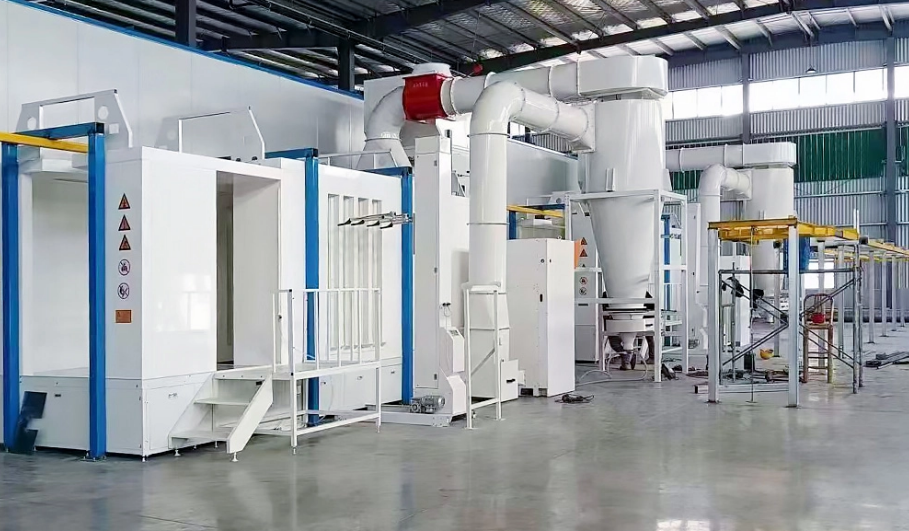
Industrial finishing requires precise environmental control. Engineers design spray enclosures to execute specific physical tasks. You cannot achieve a consistent finish without understanding these underlying mechanics.
Every commercial enclosure performs three non-negotiable roles. If one function fails, the entire process breaks down. The triad includes:
Providing a controlled electrostatic environment: The system must isolate the application zone. Drafts from the factory floor cannot interfere.
Containing combustible dust: Suspended powder creates an explosion risk. The enclosure protects the facility by trapping these particles safely.
Capturing over-sprayed material: Spray guns never achieve 100% transfer efficiency. The system must collect the excess media for recycling or safe disposal.
Airflow dictates application success. Exhaust fans create a precise negative pressure zone. Engineers typically calibrate this flow between 0.4 and 0.6 meters per second (m/s). This exact speed captures fugitive dust. However, it remains gentle enough to avoid stripping applied powder off the grounded parts.
Fluid dynamics play a crucial role here. You must choose between downdraft and cross-draft systems. Downdraft systems pull air straight down through floor grates. They work exceptionally well for heavy, dense parts. Cross-draft systems pull air horizontally across the workspace. They suit longer parts transported on overhead conveyors.
Powder adhesion relies entirely on physics. Spray guns impart an electrostatic charge to the dry particles. This charge typically reaches 40 to 50 dynes/cm. The charged powder then seeks a grounded target. It clings to the substrate until baking cures it into a solid film.
This process introduces a major operational challenge. Engineers call it the "Faraday cage effect." Complex, recessed parts repel the charged powder. Tight corners act like magnetic shields. Operators must adjust gun voltage and airflow to force powder into these blind spots. Failure to manage the Faraday cage effect leaves bare metal exposed.
Moving from wet spray to dry finishing transforms facility management. The underlying technology changes completely. You must rethink your maintenance schedules and operating budgets.
Filtration logic shifts fundamentally. Powder systems handle dry waste. They eliminate wet solvents entirely. This transition removes the hazardous byproducts of traditional painting.
Feature | Liquid Paint Systems | Powder Coating Systems |
|---|---|---|
Waste State | Wet, toxic solvent sludge | Dry, inert particulate |
Filtration Method | Water curtains, chemical baffles | Dry cartridge or cyclone filters |
Maintenance Burden | High (frequent sludge pit cleaning) | Low (automated pulse-valve cleaning) |
Material Recovery | 0% (Overspray is lost forever) | Up to 95% (Reusable media) |
You no longer need to manage expensive water treatment protocols. Facilities escape the high costs associated with wet-curtains and toxic sludge pits. Maintenance becomes a dry, predictable sweeping process rather than a hazardous chemical cleanup.
Energy savings represent a massive financial advantage. Liquid paint systems exhaust heavily contaminated air outside. You must constantly replace this expelled air. Factories spend fortunes heating or cooling this "make-up air" to maintain comfortable indoor temperatures.
Advanced multi-stage HEPA filtration changes this equation. A Powder Coating Booth cleans its exhaust air to incredibly strict standards. You can safely return this clean air directly into the facility. This closed-loop approach drastically cuts make-up air demands. Consequently, your HVAC heating and cooling costs plummet.
Throughput velocity increases dramatically with dry media. Powder requires a specialized high-temperature curing oven. Parts typically bake for about 10 minutes at temperatures exceeding 350°F (175°C). The powder melts, cross-links, and forms a durable shell.
Once parts exit the oven, they cool rapidly. Workers can handle and assemble them immediately. You do not need staging areas for extended drying times. This immediate readiness increases overall line velocity compared to the sluggish drying times of liquid paint.
Facility managers face one critical architectural decision. You must choose between recovering overspray or prioritizing speed. This choice defines your entire production strategy.
System Type | Primary Mechanism | Target Production Profile | Key Business Outcome |
|---|---|---|---|
Filter Recovery | Cartridge/Cyclone capture & sieve return | High Volume, Low Mix (Single color runs) | Maximized material utilization (>95%) |
Spray-to-Waste | Swappable modules, smooth surfaces | High Mix, Low Volume (Frequent color changes) | Extreme agility (Changeovers under 5 mins) |
Recovery systems focus entirely on efficiency. They utilize sophisticated cartridge or cyclone systems. These mechanisms capture all over-sprayed particles before they escape the containment zone. The system then sieves the captured media to remove debris. Finally, it returns the clean powder to the main feed hopper.
This business outcome drives massive cost savings for specific operations. You achieve greater than 95% material utilization. Filter recovery remains the ideal choice for dedicated, single-color, high-production runs on an automated line.
Custom job shops face different challenges. They handle multiple color requests daily. Spray-to-waste systems prioritize flexibility over material savings. These setups utilize easily swappable filter modules. They feature smooth, anti-static interior surfaces. These surfaces actively prevent unwanted accumulation on the walls.
You sacrifice material recovery to gain extreme operational agility. Flushing a recovery system takes hours. Conversely, premium spray-to-waste systems execute color changeovers incredibly fast. Top-tier setups can switch colors in under 5 minutes. This keeps your operators spraying instead of cleaning.
Commercial setups rarely operate as standalone units. They act as nodes within a larger ecosystem. Modern systems integrate seamlessly with environmental controls. They connect to position encoders tracking part movement. They communicate with automated conveyor systems. Together, these elements form a highly cohesive powder coating line. This digital handshake ensures precise triggering, saving powder and reducing manual rework.
Building a reliable enclosure requires specific material choices. Small mistakes in construction lead to massive quality control issues later. Pay attention to the physical materials surrounding your spray zone.
Never construct your walls using painted materials. Ordinary paint interferes with electrostatic grounding. It also encourages dry particles to stick stubbornly to the surfaces. This makes cleaning between batches nearly impossible.
Industry best practices dictate specific materials. Use unpainted, bare galvanized steel or stainless steel. These metals offer optimal grounding pathways. Alternatively, invest in high-tech polymers like polypropylene or polycarbonate. These advanced plastics naturally resist electrostatic adhesion. Powder literally falls off them, drastically speeding up your clean-down procedures.
Electrostatics demand perfect grounding. The charged particles must find a direct path to the earth. Improper grounding of the booth walls, floor grates, or part-hangers creates severe operational headaches.
Poor grounding ruins transfer efficiency. Most of the powder will end up in your filters instead of on your parts. It also causes back-ionization, resulting in an ugly, textured finish resembling an orange peel. Furthermore, ungrounded metal components store electrical charges. This creates dangerous sparking hazards in a dust-rich environment.
Visual inspection happens before curing. Operators must see exactly how much material they have applied. Standard shop lights fail in this environment. The suspended dust quickly coats standard fixtures, dimming the workspace.
You need high-lumen, shadow-less, explosion-proof LED lighting. These fixtures must withstand the abrasive environment. Proper illumination ensures operators can accurately gauge mil-thickness before baking. Coating quality drops significantly if applied thinner than 40-60 microns. Operators cannot spot thin areas without brilliant, even lighting.
Industrial equipment requires rigorous safety protocols. You cannot operate high-voltage equipment in a dusty environment without strict rules. Preventive maintenance guarantees consistent finish quality.
You must protect your shop from invisible threats. Silicone contamination destroys batch yields. Keep silicone-based sealants, industrial lubricants, and even personal deodorants far away from your equipment.
Silicone possesses an extremely low surface tension, usually measuring 15-20 dynes/cm. Conversely, your finishing media measures 40-50 dynes/cm. When a stray silicone molecule lands on a part, it repels the surrounding finish during the melting phase. Even 0.001% contamination causes "fish-eyes"—deep craters in the final surface. This leads to catastrophic batch rejection and massive rework costs.
Regulatory compliance keeps your facility safe from explosions. Combustible dust presents a lethal hazard if ignored. You must adhere to strict National Fire Protection Association (NFPA) and OSHA guidelines.
Regulations require maintaining suspended dust levels well below 50% of the Lower Explosive Limit (LEL). You achieve this through proper exhaust fan sizing. Furthermore, the law mandates explosion-proof motors on all extraction units. You must also install safety interlocks. If the exhaust fan fails, the interlock instantly cuts power to the spray guns and the curing oven.
Consistent maintenance prevents catastrophic downtime. Implement strict Standard Operating Procedures (SOPs) for your team. A proactive schedule protects your capital investment.
Daily: Check pulse-valves to ensure filter cleaning functions properly. Monitor pressure drop gauges across your filter banks. A high pressure drop indicates clogged media.
Weekly: Perform thorough wall washes using approved solvents. Clean your LED light fixtures to maintain visibility. Scrape baked-on residue off your part-hangers to restore grounding.
Periodically: Conduct "smoke tests" inside the empty enclosure. Release non-toxic smoke and watch the extraction patterns. This reveals hidden airflow blind spots or dangerous seal failures around your doors.
Selecting the right equipment requires a deep understanding of your production goals. You must balance the upfront capital expense against long-term operational savings. A well-designed setup acts as the heart of your entire finishing process.
Decision Summary: Choosing your configuration hinges on a specific TCO ratio. You must weigh material waste against labor and changeover time. High-volume single-color runs demand recovery systems. High-mix custom jobs require fast-color-change setups.
Assess Your Footprint: Audit your required CFM (Cubic Feet per Minute) capacity. Carefully measure your largest expected part dimensions. Do not buy an enclosure that barely fits your current inventory.
Seek Expert Guidance: Consult an integration engineer early in the process. They will map the enclosure seamlessly to your broader material handling systems and curing infrastructure. Proper integration prevents bottlenecks.
A: No. Unlike liquid paint, mixing dry powders results in a speckled, multi-colored finish. It will not melt into a newly blended, uniform color. The distinct particles remain separate during the curing process.
A: Basic spray-to-waste systems take 15-30 minutes for a manual clean-down. High-end automated booths featuring aerodynamic floors, pneumatic air-washes, and roll-out filter modules can execute full color changes in under 5 minutes.
A: The limitation is not the booth, but the oven. Because the media requires high heat (often >350°F) to cross-link and cure, traditional methods cannot be applied to non-conductive or heat-sensitive materials like rubber or low-melt plastics.


