

close
Choose Your Site
Global
Social Media
Views: 0 Author: Site Editor Publish Time: 2026-08-10 Origin: Site


Rinsing is often described as a cleaning step, but in an Electrophoretic Coating Line it is a quality-control and material-management stage. A workpiece leaving the deposition tank carries a fresh film plus liquid, excess paint solids, and dissolved components on its surface. If that carryover is handled poorly, a smooth coating can become streaky, contaminated, or difficult to cure consistently. A properly designed rinse sequence protects the newly deposited film, returns recoverable paint to the system, limits contamination between stages, and prepares the part for the oven. Its performance should be evaluated as part of the whole coating process, not as a secondary utility.
Post-electrocoat rinses remove loosely held coating material without disturbing the deposited film when the rinse medium and sequence are properly controlled.
Ultrafiltration rinse stages commonly use UF permeate, which is compatible with the bath and supports paint recovery.
Final deionized-water rinsing targets residual soluble contamination before curing; it does not replace the recovery role of earlier UF stages.
Drag-out, rinse quality, nozzle condition, drainage, and recirculation affect both appearance and operating stability.
During electrodeposition, paint solids form a film on the conductive part. When the part exits, not all liquid on the surface belongs in the final coating. A mobile layer of bath liquid and excess solids remains on exposed faces, edges, recesses, and hanging points. Gravity begins pulling that liquid downward immediately. Without a controlled rinse, the runoff can dry or cure as a visible mark, leave localized excess film, or carry paint unnecessarily into downstream zones.
The freshly deposited film is also more vulnerable than the cured film. A harsh, contaminated, or poorly aimed wash can disturb it. The rinse system must clean selectively: remove what is on top of the intended film while keeping the deposited layer intact. That distinction explains why the first rinse stages are not normally treated like ordinary parts washing.
The complete process sequence also contains earlier rinses after cleaning and conversion treatment. Those pretreatment rinses prevent soil or chemical residues from reaching the e-coat bath. Post-electrocoat rinses serve a different purpose: they manage paint carryover and surface cleanliness after deposition. Both are important, but confusing their functions can lead to poor troubleshooting decisions.
Ultrafiltration separates a portion of the coating-bath liquid through membranes. The resulting permeate is largely free of paint solids while remaining chemically related to the bath. In a post-electrocoat rinse, that makes it a useful medium for washing away loosely attached coating material without introducing an abrupt, incompatible rinse condition.
The first UF rinse is commonly arranged as a spray, immersion stage, or a combination selected for the part geometry. Spray can quickly remove surface carryover on open faces. Immersion provides a gentler exchange in cavities, folds, and other features where spray coverage is limited. The removed recoverable material can be directed back toward the bath system according to the line’s process design. This is why an ultrafiltration rinse contributes to both film appearance and paint economy.
An automotive electrophoresis line offered by BONITA MACHINERY lists electrophoresis, rinsing, and drying among the line’s automated process stages. For any actual project, the number of rinses, the conveyor dwell time, and the return routing should be specified against the paint supplier’s chemistry and the workpiece’s shape rather than copied from another installation.
The exact number of tanks and sprays varies, yet the logic of a robust sequence is consistent. First remove the bulk of recoverable carryover with a compatible medium. Then continue the dilution and exchange in controlled stages. Finally remove soluble residues before the oven with sufficiently clean final rinse water.
Rinse function | What it is meant to control | What to check during operation |
|---|---|---|
Initial UF spray or immersion | Excess paint on the part surface and immediate runoff | Spray coverage, flow pattern, return path, and whether complex parts drain freely |
Subsequent UF rinse | Further dilution while protecting the fresh film | Permeate availability, cleanliness, circulation, and consistent part immersion |
Final DI-water rinse | Soluble residues that could remain before cure | Water quality, conductivity trend, nozzle cleanliness, and avoidance of stagnant zones |
Drain zone before oven | Liquid carryover and water marks | Part orientation, dwell time, drip paths, and airflow that does not disturb the film |
The stages work best as a cascade rather than isolated tanks. If the first stage becomes too contaminated, its ability to remove excess paint cleanly declines. If the final rinse quality falls, dissolved residues can remain after water evaporates. If drainage is inadequate, even a good rinse sequence can leave marks where liquid collects and runs during the transition to cure.
Drag-out is the process liquid carried by a part from one stage to the next. It is affected by surface area, part geometry, withdrawal speed, dwell time, racking angle, and how well cavities drain. High drag-out increases paint loss from the bath and contaminates rinse stages more quickly. It can also make simple operating signals misleading: a rinse tank may appear to have enough flow while still receiving more coating material than the recovery loop can manage.
Start with the workpiece. A horizontal channel can carry a large volume of liquid; a small drain opening can slow emptying; parts packed closely together can create bridges of liquid between them. Adjusting the rack angle or adding an appropriate drain feature may reduce carryover more effectively than increasing rinse flow. The goal is not to make the part drip less at any cost, but to make its wetting and drainage repeatable.
Then review the hardware. Spray nozzles need uniform coverage and should not be partially blocked, misaligned, or producing an overly aggressive jet on a soft film. Pumps, filters, valves, and return piping need enough capacity to sustain the specified rinse pattern. Tank overflow and make-up water must be managed so that contamination does not simply move downstream and accumulate. These are routine controls, but they become especially important when production rate, part size, or paint solids change.
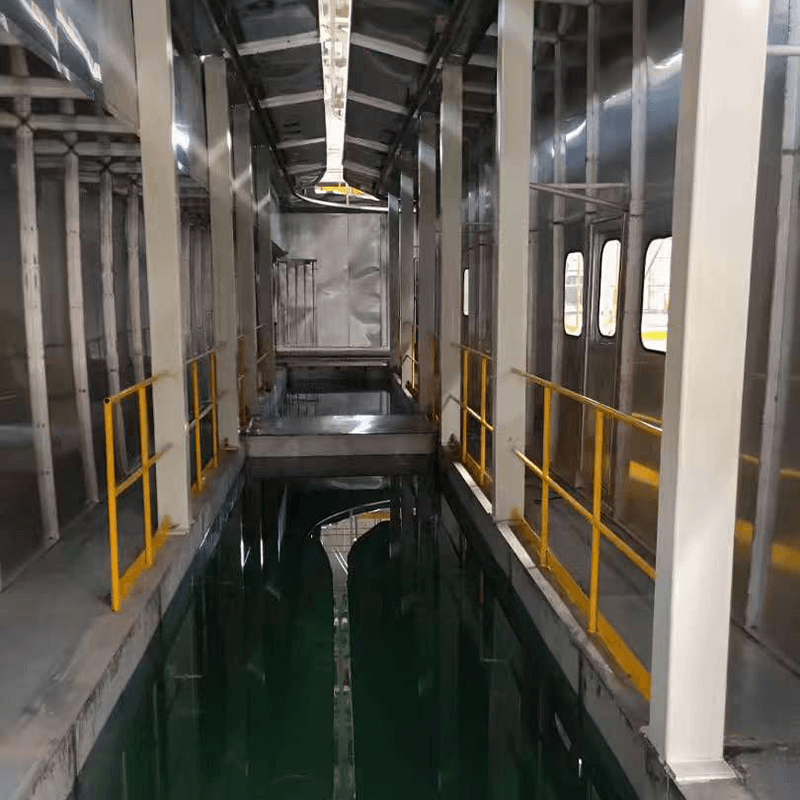
Many cured-film defects have several possible causes, so the defect location and process history matter. A streak descending from a ledge may suggest drainage or rinse flow. A small crater can point to contamination from an earlier stage, compressed air, handling, or the environment. A dull area inside a cavity may involve insufficient rinse exchange, but it may also reflect poor pretreatment or the original deposition condition. Changing bath chemistry first can hide the pattern without solving it.
Use a simple troubleshooting sequence. Compare a conforming part and a nonconforming part from the same shift. Record their rack position, orientation, withdrawal behavior, rinse stage settings, and cure conditions. Inspect the issue before and after baking where practical. Check the final-rinse water quality and the physical condition of nozzles and filters. If the defect remains tied to a specific feature, inspect drainage and access rather than treating it as a line-wide chemistry problem.
This approach also supports preventive control. Sampling final-rinse conductivity, observing spray coverage, checking membrane and filter condition according to the equipment plan, and recording abnormal carryover trends give operators early warning. The exact sampling frequency should be set by the coating supplier, production volume, and process-validation plan.
When discussing an electrophoretic coating line, give the equipment provider representative parts and identify the features that retain liquid: closed boxes, channels, deep recesses, horizontal flanges, and welded overlaps. Confirm the intended paint system and the required final-surface standard. Ask how the design accommodates UF permeate generation, rinse recirculation, filtration, tank cleaning, drainage, and final DI-water quality.
It is also useful to define how the line will be maintained during changeovers and low production periods. Stagnant zones, unmonitored filters, and idle pumps can affect the next start-up. A design that allows inspection, flushing, and access to nozzles is easier to keep stable than one that treats rinse equipment as hidden pipework.
BONITA MACHINERY’s electrophoretic coating line range is intended for configurable metal-finishing workflows. The right rinse configuration depends on the chosen coating chemistry, part design, recovery target, production rate, and site water conditions.
The first loads after a shutdown, filter service, membrane procedure, bath adjustment, or extended idle period deserve a planned review. Confirm that circulation has returned to normal, rinse levels and flows are stable, nozzles are operating as intended, and the part path is clear. Observe representative parts through drainage and after cure before releasing the full production schedule. A restart is a moment when air, settled contamination, unusual carryover, or a missed valve position can reveal itself.
This need not become a lengthy inspection ritual for every stop. The right approach is a documented, risk-based check that fits the equipment and production plan. A brief visual verification plus defined process readings may be sufficient after a routine pause, while a deeper review may be required after membrane cleaning or a bath intervention. By defining those levels in advance, teams avoid unnecessary delay and the temptation to restart without confirming the stages that protect film quality.
In addition, verify the relationship between part geometry and rinse performance during these checks. A small test panel may look clean while a deep channel, threaded feature, or welded overlap retains liquid. Include a representative difficult part in restart inspection, especially after a change to racks, production rate, paint chemistry, or rinse settings. This gives the team a practical early indicator before the line returns to full output.
Keep the observations comparable. Use the same rack orientation, inspection location, and acceptance criteria that were used during process validation. If a restart check produces an unusual result, preserve the part and process record before making broad adjustments. This makes it easier to distinguish a temporary start-up condition from a real shift in rinse performance.
Rinsing converts a deposited film into a clean, cure-ready workpiece while recovering material that should not be lost. In an Electrophoretic Coating Line, UF stages, final DI rinsing, controlled drainage, and clean recirculation each have separate but connected roles. Stable results come from treating carryover and rinse quality as measurable process variables, not as afterthoughts. BONITA MACHINERY can integrate rinsing within an automated coating workflow, but the detail should be validated using the actual parts, paint system, and water-management requirements.
UF permeate can remove excess coating material while remaining compatible with the paint bath. That helps protect the fresh film and allows recoverable material to be managed in the process loop.
Not usually. DI water is valuable for the final cleanup of soluble residues, while early UF rinses are designed for compatible film stabilization and paint recovery.
Drag-out is liquid carried from one tank into the next on the workpiece. It is influenced by shape, racking, withdrawal, drainage, and production loading.
Yes. Uncontrolled runoff, contaminated rinse stages, uneven spray coverage, and poor drainage can leave localized deposits or flow marks that become visible after baking.
There is no single universal measurement. Final-rinse water quality, conductivity trends, flow coverage, filter condition, and visual inspection of representative parts should be considered together within the validated process plan.


