

close
Choose Your Site
Global
Social Media
Views: 0 Author: Site Editor Publish Time: 2026-08-10 Origin: Site


High defect rates, rework costs, and inconsistent aesthetics directly erode manufacturing margins. Relying on outdated manual application methods creates a serious quality bottleneck you simply cannot afford in today's competitive automotive market. Upgrading from manual operations or legacy systems to a purpose-built Automotive Painting Line transforms finish quality from an unpredictable variable into a tightly controlled output. It shifts your entire production floor into a highly efficient environment capable of replicating OEM-level perfection.
Evaluating a new painting setup requires moving beyond basic technical specifications. You must understand how specific system architectures and strict environmental controls directly eliminate common finish defects. Soon, you will discover the exact robotic mechanisms and structural designs these systems use to guarantee flawless results. You will learn how modern equipment reduces material waste and protects your long-term profitability while scaling your production capabilities.
Automated Consistency: Modern painting lines eliminate human variability, ensuring precise mil thickness and uniform application.
Environmental Control: Integrated spray booths and HVAC systems drastically reduce airborne contaminants, mimicking OEM-level factory finishes.
Process Architecture: Choosing between continuous loop and start-stop systems dictates both production flexibility and baseline finish consistency.
Predictable ROI: Advanced coating lines reduce rework and material waste, offering measurable returns despite high initial capital expenditures.
Many manufacturers underestimate the hidden costs tied to acceptable manual finishing. Manual processes inherently breed inconsistency. Painters experience fatigue. Environmental variables shift throughout the day. These fluctuations lead to increased rework rates. Rework introduces massive labor bottlenecks. It forces skilled technicians to spend valuable hours sanding and respraying flawed parts. Furthermore, manual application often leads to excessive paint consumption. Operators naturally apply thicker coats to compensate for uneven coverage. This wastes expensive basecoats and clearcoats. Over time, these hidden expenses heavily impact your profit margins.
Unstable environments guarantee surface defects. Uncontrolled humidity alters drying times. Fluctuating temperatures change fluid viscosity. These variables directly cause orange peel textures. Drafts and unfiltered air introduce microscopic dust particles. These particles create dirt inclusions on the final surface. Manual inconsistencies also cause severe application errors. Inconsistent spray gun speed leads to cut-off lines and uneven blending. Poor overlap techniques result in visible striping. You cannot easily correct these defects once the clearcoat cures. Preventing them requires eliminating the environmental and human variables triggering them.
Factory-grade finishes inherently outperform aftermarket or batch-sprayed alternatives. They rely on tightly controlled sequential processing. Original Equipment Manufacturers (OEMs) do not leave environmental conditions to chance. They isolate every stage of the application process. Vehicles move through dedicated zones for prep, basecoat application, flash-off, and clearcoat. Strict climate controls govern each zone. This sequential approach guarantees repeatable mil thickness. It ensures perfect color matching across hundreds of panels. Replicating this standard requires adopting automated architectures designed for absolute environmental stability.
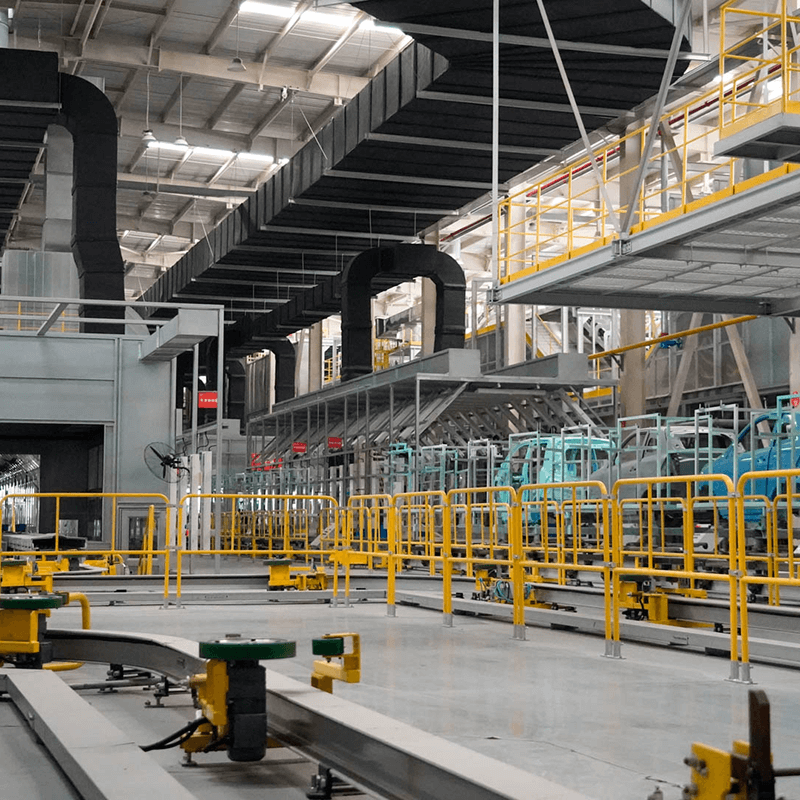
Modern booths utilize advanced downdraft airflow systems to protect the finish. Clean air enters through ceiling filters. It flows straight down over the vehicle surface. Floor grates then pull the air out. This downward velocity instantly removes overspray. It prevents airborne particulates from settling onto wet surfaces. Multi-stage filtration removes microscopic contaminants from the intake air. This isolation guarantees an incredibly clean application environment. Furthermore, strict exhaust filtration ensures regulatory compliance. It captures volatile organic compounds (VOCs) before they escape the facility. Upgrading your Painting Line with robust isolation drastically cuts dirt inclusion rates.
Intake Filtration: Removes incoming dust and pollen particles.
Downdraft Velocity: Pushes overspray downward away from the substrate.
Exhaust Scrubbing: Captures hazardous VOCs to meet environmental codes.
Climate Control: Locks in precise temperature and humidity targets.
Robotic atomization replaces manual guesswork with mathematical precision. Rotary bell atomizers spin at high speeds to shear fluid into uniform droplets. This guarantees consistent droplet sizing for flawless coverage. Furthermore, electrostatic application maximizes transfer efficiency. The system applies a negative charge to the atomized particles. It grounds the automotive panel. The grounded metal literally attracts the charged fluid. This magnetic-like attraction wraps the paint around complex curves. It dramatically reduces overspray. Electrostatic technology ensures you apply more material to the part and less into the exhaust filters.
Curing involves complex chemical reactions. It requires much more than simple heat. Integrated flash-off zones allow solvents to evaporate slowly. This prevents solvent popping and blistering in the subsequent layers. Following flash-off, parts enter dedicated baking ovens. Convection and infrared heating technologies stabilize the cross-linking process. This process binds the clearcoat and basecoat molecules together. Controlled curing environments ramp up temperatures according to strict curves. This prevents thermal shock. It guarantees a durable, mirror-like finish capable of withstanding harsh outdoor elements.
Continuous loop architectures keep parts moving constantly via conveyors. They maximize overall throughput. This design enforces strict flash-off and curing timing. Parts never sit idle between stages. It creates highly predictable finish quality. You can accurately forecast daily production volumes. However, continuous systems have distinct drawbacks. They are less adaptable to sudden production changes. Switching colors or part sizes on the fly proves difficult. You must carefully schedule production runs to maintain peak efficiency.
Start-stop operations move parts into a zone, stop for processing, and then move again. They offer massive flexibility. You can easily process mixed-part runs and complex geometries. They handle customized batches effortlessly. However, this flexibility introduces potential variables. Stopping and starting exposes parts to handling risks. It alters environmental exposure times between stages. Consistency relies heavily on strict operator protocols. You must tightly monitor transfer times to prevent unwanted flash-off variations.
Aligning system architecture with your facility requires careful planning. You must evaluate your available footprint. Continuous loops require massive, uninterrupted floor space. Start-stop systems fit better into fragmented or compact facilities. You must also consider part volume. High-volume, standardized production demands a continuous loop. High-mix, low-volume production favors start-stop flexibility. Evaluate your specific product mix carefully. Choose the architecture matching your highest priority production goals. A robust Coating Line investment heavily depends on this alignment.
Architecture Comparison Matrix
Feature Category | Continuous Loop Systems | Start-Stop Operations |
|---|---|---|
Throughput Rate | Exceptionally high. Ideal for mass production. | Moderate. Better suited for custom batches. |
Process Consistency | Strictly enforced by constant conveyor speed. | Variable depending on operator timing. |
Flexibility | Low. Color/part changes require careful planning. | High. Easily adapts to mixed-part geometries. |
Footprint Needs | Requires long, uninterrupted linear space. | Can adapt to compact or segmented facility layouts. |
Perfect atomization requires consistent fluid rheology. Automated dosing systems manage this directly. They constantly measure the raw material inputs. Temperature tracking mechanisms keep the fluid at an optimal state. Cold material thickens and creates uneven textures. Hot material thins out and causes runs. Inline heaters and chillers automatically adjust the fluid temperature before it reaches the applicator. This proactive control maintains optimal viscosity. It guarantees the applicators always spray material matching the required chemical specifications.
Reactive quality checks happen too late. Advanced setups integrate vision systems directly into the flow. Scanners analyze the wet film immediately after application. They identify micro-defects in real-time. Cameras detect dirt inclusions, thin spots, or sagging edges. The system flags these flawed parts instantly. It prevents them from entering the final curing stage. Operators can pull the part, clean it, and respray it quickly. This real-time detection saves the enormous cost of stripping and recoating fully baked panels.
Transitioning from reactive quality assurance to proactive control requires smart sensors. Data-driven adjustments eliminate operator guesswork.
Baseline Establishment: Sensors record ideal temperature, humidity, and flow rate parameters during a perfect run.
Continuous Monitoring: The system tracks real-time data against this established baseline continuously.
Automated Corrections: Programmable logic controllers (PLCs) tweak fluid delivery or fan speeds instantly when metrics drift.
Trend Analysis: Management reviews historical data to predict maintenance needs before mechanical failures occur.
Retrofitting an existing plant involves major spatial constraints. HVAC load requirements demand heavy engineering. High-volume spray booths pull massive amounts of air. Your facility must supply adequate make-up air to prevent negative pressure. Structural modifications often prove necessary. Heavy ducting requires reinforced roof supports. You must plan the layout carefully to avoid disrupting other assembly processes. Miscalculating these facility integration hurdles leads to massive project delays and budget overruns.
Handling atomized solvents introduces severe safety risks. You must navigate stringent local environmental regulations. Authorities mandate strict VOC emissions capture limits. Thermal oxidizers often accompany large installations to burn off hazardous exhaust. Additionally, you must meet strict fire suppression standards. National Fire Protection Association (NFPA) codes dictate specific sprinkler layouts and explosion-proof electrical fixtures. Navigating these compliance codes requires specialized engineering partners. Ignoring them results in heavy fines or catastrophic facility fires.
Installing complex machinery guarantees significant downtime. You must anticipate and plan for this production pause. Furthermore, operators face a steep learning curve. Transitioning from manual spray guns to automated HMI (Human-Machine Interface) touchscreens requires extensive training. Technicians must learn how to program robotic paths and interpret sensor data. A sudden technological leap often causes initial frustration. Providing adequate training resources mitigates this adoption curve. It empowers your team to maximize the new equipment's capabilities quickly.
You cannot measure improvement without clear baseline KPIs. Establish your current First Run Yield (FRY). This metric tracks parts passing quality control without any rework. Measure your existing material transfer efficiency. Track the exact per-unit cycle time. A successful upgrade must dramatically improve these specific metrics. Set aggressive but realistic goals for your new equipment. Demand vendors demonstrate exactly how their proposed architecture will achieve your desired FRY improvements.
Look beyond the initial capital expenditure. You must evaluate the long-term operational impact. Assess the vendor's maintenance Service Level Agreements (SLAs). Ensure they guarantee rapid response times for critical part replacements. Evaluate the system's energy consumption metrics. Highly efficient motors and heat recovery systems drastically reduce monthly utility bills. Finally, look for scalable modularity. Choose architectures allowing you to add future robotic arms or curing zones easily. This modularity ensures your investment grows alongside your production demands.
Conduct a comprehensive facility audit immediately. Map out your available floor space and current HVAC capacities. Document your precise throughput goals. Once you shortlist potential integrators, demand tangible proof of concept. Request pilot testing using your specific part geometries. Ask for fluid dynamics simulations showing airflow within their proposed booth designs. These simulations reveal potential dead zones before you finalize the purchase. Actionable data protects your investment and ensures successful implementation.
A well-architected finishing infrastructure represents much more than simple application equipment. It serves as a comprehensive environmental and process control system. It removes human inconsistency and environmental chaos from your production floor. By controlling airflow, fluid viscosity, and curing temperatures, you guarantee repeatable perfection.
Prioritize vendors demonstrating transparent ROI modeling through material savings and rework reduction. Demand clear, documented paths for mitigating complex installation risks and facility integration hurdles. Ensure they provide robust operator training programs.
Stop letting unpredictable finish quality dictate your profit margins. Schedule a technical consultation with an integration specialist today. Map out your integration strategy and download a comprehensive facility readiness checklist to begin your upgrade journey.
A: OEM factory finishes rely on tightly controlled, static environments. They eliminate variables like dust and temperature fluctuations. Factories utilize robotic electrostatic application, wrapping paint evenly around panels with maximum transfer efficiency. Furthermore, factory setups use high-heat baking environments to accelerate cross-linking. This creates a highly durable, perfectly uniform finish that manual resprays simply cannot replicate.
A: Automated systems utilize continuous flow processing and robotic precision. Robots execute exact, programmed paths, ensuring perfectly feathered overlaps on every pass. This eliminates the heavy cut-off lines caused by manual fatigue. Additionally, automated dosing systems maintain standardized mixing ratios and constant fluid temperatures, guaranteeing absolute color consistency across every batch.
A: The timeline varies based on production volume, but most facilities see returns within 18 to 36 months. This return stems from massive reductions in paint waste due to electrostatic efficiency. Additionally, automated systems drastically lower labor costs and nearly eliminate the expensive bottleneck of manual rework and defect correction.
A: Yes, but it requires extensive planning. Continuous loops demand large, linear footprint requirements. You must assess structural load capacities for heavy conveyor supports. Additionally, your facility needs sufficient HVAC capacity to handle massive make-up air requirements and thermal oxidizer integration. Specialized engineering is crucial for a successful retrofit.


