

close
Choose Your Site
Global
Social Media
Views: 0 Author: Site Editor Publish Time: 2026-09-03 Origin: Site


Transitioning from outsourced finishing to an in-house operation requires a massive commitment. You cannot simply buy standalone machines and hope they sync perfectly. Success demands moving toward a fully integrated, synchronized system. A true industrial finishing setup eliminates frustrating production bottlenecks. It ensures a highly repeatable mil-thickness across every single batch. Furthermore, it easily meets stringent environmental compliance standards. You must align your production goals directly alongside your equipment capabilities.
Before you evaluate manufacturers, you must understand the exact components needed. Buyers require deep knowledge of the mechanical, electrical, and thermal units involved. In this guide, we break down what makes a highly efficient system function. You will learn the specific roles of pretreatment, application, curing, and conveyance. We also cover how you can avoid critical bottlenecks during implementation.
A fully integrated powder coating line requires four primary zones: pretreatment, application, curing, and material handling.
Pretreatment configurations (e.g., 3-stage vs. 5-stage wash) directly dictate the corrosion resistance and warranty viability of the finished product.
Powder application equipment selection hinges on required transfer efficiency, color-change frequency, and powder recovery (reclaim) capabilities.
Evaluating a coating line requires balancing facility footprint constraints and utility availability (gas/electric).
We must define the setup not as a collection of individual machines. It acts as a continuous, unified workflow. Engineers design this entire workflow around the "part envelope." This envelope represents the maximum physical size and weight of your coated product. Every module must accommodate these exact dimensions smoothly.
A properly scaled Powder Coating Line relies on four distinct pillars. These pillars work together seamlessly to produce a flawless finish.
Surface Preparation (Chemistry and Mechanical Processing)
Powder Application and Material Recovery
Thermal Curing and Cooling
Conveyance and System Automation
Implementation carries specific risks. Undersizing even one module automatically throttles the throughput of the entire line. For example, a slightly undersized oven will force you to slow down the conveyor. This happens regardless of how fast your application guns spray. You must balance every zone perfectly.
Industry consensus highlights a staggering reality regarding finish quality. Inadequate pretreatment causes nearly 80% of all powder coating failures. Delamination and under-film corrosion originate right here. You must build a strong foundation before any powder touches the metal.
Modern industrial washers utilize multi-stage chemical processes. They prepare the raw substrate for maximum powder adhesion.
Alkaline Wash and Rinse: This initial stage removes heavy oils. It clears away laser scale, drawing compounds, and fabrication debris.
Phosphate or Zirconium Conversion Coating: This creates a necessary micro-texture on the metal. Powder adhesion requires this specific crystalline or nano-ceramic surface profile.
Sealer and RO Rinse: Reverse Osmosis (RO) water ensures zero chemical residue remains. Hard water salts cause blistering, so parts must be perfectly clean.
The dry-off oven acts as a critical thermal bridge. It connects the wet pretreatment phase to the dry powder application stage. This high-velocity oven evaporates remaining surface water rapidly. It prevents flash rust from forming on freshly washed steel. It also eliminates moisture defects trapped in tight seams.
Buyers must weigh the evaluation metric of footprint versus efficacy. A compact 3-stage system works well for standard indoor parts. However, a robust 5-to-7-stage system provides superior protection. You will need a larger system for harsh outdoor environments or strict AAMA-compliant architectural finishes.
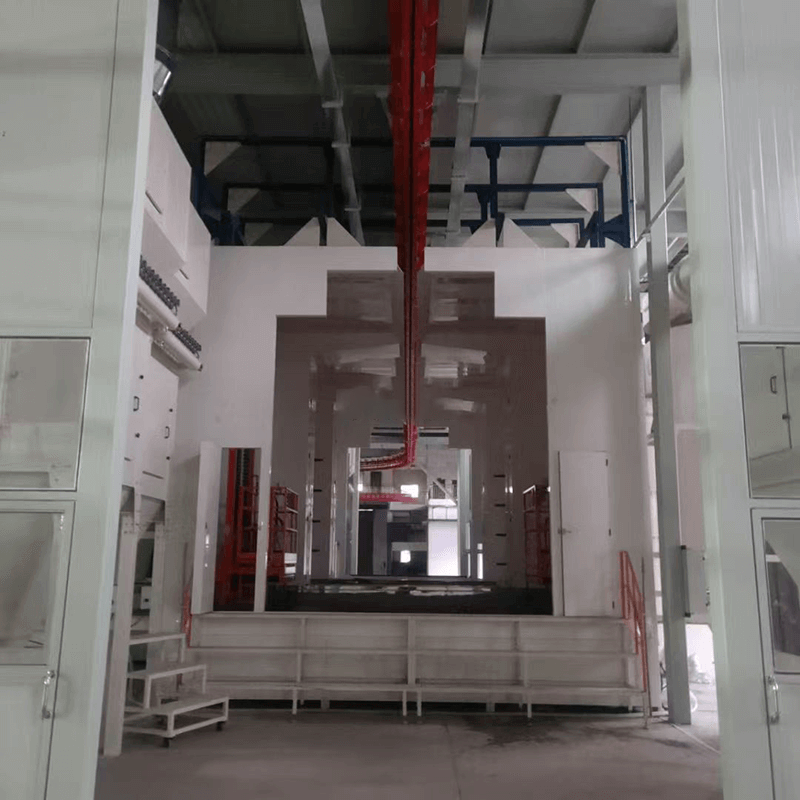
Visual quality heavily depends on this operational phase. Material waste metrics and finish consistency are determined inside the application zone.
Booths serve a dual purpose. They contain hazardous overspray and maintain safe airflow velocities. Proper design ensures strict compliance with NFPA and OSHA safety standards. You must maintain specific face velocities to prevent powder from escaping into the facility.
Material selection for the booth cabin plays a major role in efficiency.
Feature | Stainless Steel Booths | Polypropylene Booths |
|---|---|---|
Material Reaction | Attracts and holds powder on walls | Repels powder effectively |
Color Change Speed | Slower, requires heavy squeegee cleaning | Faster, allows rapid pneumatic blow-downs |
Illumination | Reflects light well, but can cause glare | Provides bright, diffused lighting conditions |
Selecting the right electrostatic technology depends heavily on your part geometry. Corona charging uses a high-voltage electrode to ionize powder particles. It works wonderfully for flat panels. However, Corona guns struggle with the Faraday cage effect, where powder refuses to enter tight corners. Tribo charging relies on friction inside the gun barrel. It creates no electromagnetic field, making it ideal for deep recesses and complex geometries.
Facility managers must also balance manual touch-up stations against automatic reciprocators. Automated robotic gun movers provide incredible precision. They ensure a perfectly even film build while reducing daily labor requirements.
Assessing reclaim efficiency directly impacts your long-term material consumption. Cartridge-style recovery systems work well for single-color operations. However, cyclone recovery systems dominate modern multi-color lines. Cyclones allow for rapid color changes. They separate usable powder from ultra-fine waste efficiently. Reclaiming up to 95% of your overspray drastically cuts down on consumable material purchases.
Curing dictates the final mechanical properties of the powder. The cross-linking process happens inside these heated chambers. Heat transforms dry, dusty powder into a durable, solid shell.
Gas-fired convection ovens represent the industry standard. They handle complex geometries perfectly. Convection relies on consistent ambient hot air circulating around the part. However, convection ovens require massive floor space to achieve proper cure times.
Infrared (IR) boosters offer a targeted alternative. IR relies on direct line-of-sight technology. It rapidly gels the powder before the part enters the main convection chamber. This prevents powder from blowing off. It also shrinks the total necessary footprint of the oven system.
Engineers calculate "Time-at-Temperature" during the design phase. You must size the oven to accommodate the mass of the heaviest part. You must also account for the heavy steel conveyor chain. Ambient air temperature alone does not cure the powder. The actual metal substrate must reach the required temperature. Integrating these calculated thermal units within your broader Coating Line ensures uniform finish quality across every batch.
Finally, evaluate your local utility realities. Compare natural gas availability against industrial electrical rates. This helps determine the most viable heating method for your location.
Conveyance serves as the structural backbone of the entire workflow. It dictates your line speed. It also controls your overall production throughput.
Enclosed Track Conveyors: These serve as the standard for medium-weight parts. The enclosed tube protects the moving chain from powder overspray and harsh chemical contamination.
I-Beam Conveyors: You need these for heavy-duty, high-capacity fabrication loads. They support massive structural steel pieces and large agricultural equipment.
Power-and-Free Systems: These offer advanced logic handling. They allow parts to buffer, switch tracks, or pause inside curing zones. They accomplish this without stopping the entire production line.
You must also review structural considerations. Floor-mounted configurations work well in leased buildings. Roof-supported configurations keep the floor entirely clear. However, roof-mounted systems require a rigorous assessment of your facility's structural roof load capacity.
Business buyers need a strict decision framework. You must sequence your purchasing decisions logically to avoid mismatched equipment.
Establish these baseline metrics before submitting vendor RFQs:
Maximum part envelope (Length x Width x Height) and total hanging weight.
Target throughput measured in parts per hour or per shift.
Available facility square footage and maximum ceiling height.
Anticipated color change frequency per shift.
Look for vendor trustworthiness above all else. Seek out true systems integrators. They should perform rigorous facility audits before quoting. They provide clear throughput guarantees. Avoid vendors who merely sell isolated catalog components without considering the holistic system.
Building a reliable powder coating system requires careful alignment of multiple disciplines. You must balance pretreatment chemistry, precise electrostatic application, thermal curing, and robust conveyance. Avoid piecemeal purchasing at all costs. Proper integration between components ensures safety interlocks function correctly. It keeps line speeds synchronized and environmental controls tight.
Begin your journey with a detailed part-envelope analysis. Conduct a thorough facility utility audit. Gather your electrical and gas capacity data. Only then should you solicit bids from reputable systems integrators.
A: Space requirements depend entirely on your line speed and part size. A continuous setup can require anywhere from 3,000 to over 10,000 square feet. Oven curing times dictate much of this footprint. Cooling zone lengths also add significant distance. You must measure your available floor plan carefully before committing to a layout.
A: Batch systems require manual transfer of parts between standalone booths and ovens. This involves intense manual labor and yields lower production volumes. Automated lines use a continuous overhead conveyor linking all stages. They handle high-volume production easily. They also reduce the manual handling time per part drastically.
A: Conversion presents harsh realities. You can sometimes repurpose existing conveyors and certain wash stages. However, you must completely replace the application booths and recovery systems. Curing ovens also require replacement, as powder requires significantly higher curing temperatures than liquid paint.
A: "Spray-to-waste" systems lose 30% to 50% of the sprayed powder. Implementing a cyclone recovery system recaptures that lost material. Reusing overspray directly minimizes waste. It drastically lowers your consumable material purchases. This makes the entire finishing process highly efficient over the first two years of operation.


