

close
Choose Your Site
Global
Social Media
Views: 0 Author: Site Editor Publish Time: 2026-07-18 Origin: Site


Transitioning to an electrophoretic coating process represents a highly strategic capital expenditure. Manufacturers pursue this upgrade driven by the critical need for superior corrosion resistance and high-volume consistency. Traditional finishing methods often fall short when scaling up operations. While e-coating acts as the gold standard for complex geometries, adopting this technology demands rigorous validation. You must evaluate production volume, facility footprint, and strict industry-specific compliance requirements before making a decision.
This article breaks down exactly which sectors rely heavily on this technology today. We will evaluate the core business case for adoption and highlight the implementation realities facing plant managers. Procurement engineers will also learn actionable strategies to source the right system. Read on to determine if upgrading your finishing operations aligns smoothly with your factory's production demands.
The automotive and heavy machinery sectors remain the primary adopters of the Automotive Electrophoresis Line, driven by stringent salt-spray test requirements and complex part geometries.
Justifying an electrophoretic coating line requires evaluating specific success criteria: minimum production volumes, part density, and the necessity for uniform film thickness in recessed areas.
Integrating a new coating line involves significant facility considerations, including wastewater treatment (RO systems), curing oven footprint, and automated racking design.
Selecting between e-coating and powder coating depends heavily on automation readiness, environmental compliance mandates, and baseline unit economics.
Factory managers often struggle against the limitations of traditional liquid spray systems. Spray applications frequently result in uneven surface coverage and inconsistent thicknesses. High overspray waste heavily erodes profit margins over time. Furthermore, complex parts inevitably trigger the Faraday cage effect. This electromagnetic phenomenon prevents sprayed paint particles from penetrating internal corners and deep recesses. Ultimately, these unpainted cavities become vulnerable starting points for aggressive rust.
To justify a technological upgrade, you must evaluate specific success criteria. Transfer efficiency stands as a primary driver. An electrophoretic process achieves an astonishing 95% utilization rate of the paint chemistry. Closed-loop ultrafiltration systems continuously recover excess paint from the rinse stages. They recycle this valuable material back into the main dip tank. You dramatically reduce chemical waste and lower environmental disposal fees simultaneously.
Geometric complexity presents another decisive factor for adoption. Immersion processes allow you to coat internal cavities and recessed areas with absolute uniformity. Paint particles migrate uniformly toward the metal surface under an electrical current. Once the deposited film reaches a specific thickness, it naturally insulates the part. The electrical current then shifts to uncoated areas. This self-limiting behavior guarantees consistent structural integrity across thousands of identical units.
Finally, you must weigh per-unit costs against capital expenditure. Initial equipment costs for dip tanks, rectifiers, and ovens look high. However, the operational economics shift drastically at scale. Per-part chemical costs drop due to ultrafiltration recovery. Labor costs decrease because you automate the dipping process fully. Factories producing thousands of components daily recover their initial capital investment remarkably fast.
The automotive industry relies heavily on this technology to guarantee passenger safety and vehicle longevity. Manufacturers process underbody components, chassis, engine cradles, and full vehicle bodies through massive automated systems. An Automotive Electrophoresis Line serves as the foundational primer layer before robotic arms apply decorative topcoats. This electrically deposited primer ensures vehicles easily pass rigorous salt-spray weathering tests. Automakers confidently offer 10-year or longer anti-corrosion warranties because this primer comprehensively protects hidden internal frame structures.
Manufacturers building tractors, excavators, and industrial attachments face brutal operating environments. These machines endure extreme outdoor weathering, chemical exposure, and constant physical abuse. Engineers focus heavily on evaluating coating durability for these applications. High-durability epoxy e-coats provide the necessary foundational strength. The baked epoxy resin withstands severe impact and prevents rock chips from exposing bare steel. Agricultural implements exposed to acidic fertilizers rely on this dense chemical barrier to prevent rapid structural degradation.
The white goods sector requires both corrosion protection and flawless visual aesthetics. Facilities routinely process air conditioning compressor housings, washing machine drums, and outdoor heat exchangers. Evaluation in this sector emphasizes aesthetic smoothness and complete edge coverage. Washing machine components sit in highly humid, detergent-rich environments constantly. The electrophoretic process guarantees no sharp metal edges remain exposed before final assembly. The resulting smooth finish also allows appliance manufacturers to apply thinner decorative topcoats, saving significant material costs.
Precision manufacturing demands tight tolerances that traditional paint systems easily ruin. Companies producing server racks, switchgears, structural fasteners, and architectural hardware utilize e-coating extensively. Here, the critical evaluation dimension involves maintaining a thin, highly controlled film thickness. E-coat finishes typically measure between 15 to 30 microns. This micro-thin layer does not interfere with tight mechanical tolerances. You can successfully coat threaded bolts and nuts without causing assembly binding or requiring secondary thread-chasing operations.
The table below summarizes the specific demands driving adoption across these distinct manufacturing sectors.
Industry Sector | Primary Component Examples | Key Performance Driver |
|---|---|---|
Automotive & Tier 1 | Chassis, Vehicle Bodies, Engine Cradles | Maximum salt-spray resistance and internal cavity protection. |
Heavy Machinery | Excavator Arms, Tractor Frames | Impact resistance and tolerance to agricultural chemicals. |
Appliances & HVAC | Compressors, Wash Drums, Heat Exchangers | Aesthetic smoothness and consistent edge coverage. |
Hardware & Electrical | Fasteners, Server Racks, Switchgears | Thin film thickness to preserve tight mechanical tolerances. |
Plant managers often debate between installing a wet immersion system versus a dry powder application. You should avoid labeling one method as objectively better than the other. Instead, map each solution carefully to your specific operational scenarios. Both technologies deliver exceptional durability, but they serve entirely different production environments.
You should choose an electrophoretic coating line when you handle high volume production runs. If your parts feature complex geometries requiring complete internal coverage, immersion stands unmatched. Factories demanding absolute thickness uniformity and highly automated dipping processes benefit immensely here. The self-insulating nature of the wet chemistry ensures you never accidentally over-apply paint to exterior flat surfaces while trying to reach internal corners.
Conversely, you should choose a powder system for lower volume runs. Facilities requiring frequent color changes strongly prefer powder booths because cleaning powder guns takes mere minutes. Powder applications easily achieve thick mil builds necessary for extreme UV protection on outdoor furniture. Furthermore, if your facility lacks liquid chemical treatment permits, dry powder presents fewer regulatory hurdles regarding wastewater.
Many top-tier manufacturing facilities implement a hybrid approach. They deploy an e-coat primer followed immediately by a powder topcoat. This combination achieves maximum durability. The immersion primer seals the metal against rust perfectly. The powder topcoat provides UV resistance and vibrant custom colors. This dual-layer strategy dominates the heavy truck and premium outdoor equipment markets.
Evaluation Factor | Electrophoretic Immersion | Dry Powder Application |
|---|---|---|
Production Volume | Extremely High (Continuous) | Low to Medium (Batch Flexible) |
Color Change Speed | Very Slow / Highly Inefficient | Fast / Highly Efficient |
Internal Coverage | Excellent (Coats all wetted areas) | Poor (Subject to Faraday Cage) |
Film Thickness | Thin and Uniform (15-30 microns) | Thick and Variable (50-150 microns) |
Upgrading your plant involves undeniable friction points. Acknowledging these hurdles prepares your team for successful deployment. You cannot simply drop this equipment onto an empty factory floor without extensive pre-planning.
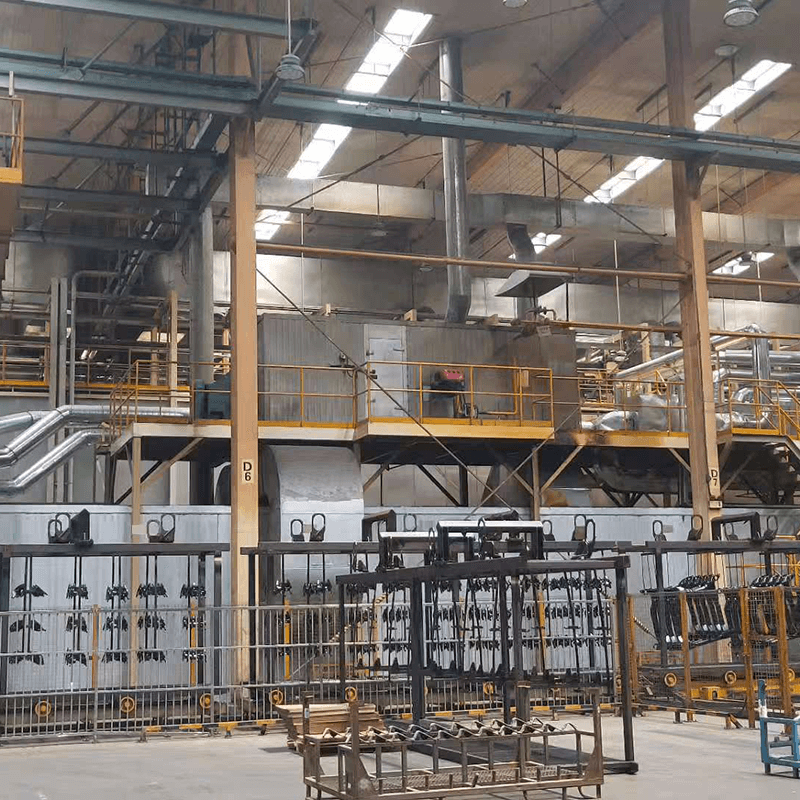
First, evaluate your facility footprint rigorously. These systems require massive linear space. A proper installation includes multi-stage chemical pretreatment tunnels, immense dip tanks, extensive drainage zones, and long curing ovens. The parts must travel through degreasing, water rinsing, phosphate conditioning, and the main paint bath. Each stage requires dedicated footprint allocation. Curing ovens must also be long enough to bring dense steel parts up to 350°F for twenty minutes continuously.
Environmental and compliance demands present the next major hurdle. The process relies heavily on ultra-pure water. You must install industrial reverse osmosis (RO) water systems to prevent bath contamination. Municipal water contains minerals that disrupt the electrical deposition process. Additionally, you need robust wastewater treatment infrastructure. Local environmental protection agencies mandate strict permitting for discharging rinse water. While modern chemistries utilize low-VOC formulations, you still manage heavy metals from the pretreatment stages.
Tooling and racking require precise engineering. You cannot hang parts using standard wire hooks. Engineers must design custom racks that ensure excellent electrical contact. The racks must present the parts at specific angles to prevent air pockets from forming in cavities during submersion. Furthermore, the angle must facilitate rapid fluid drainage. Drag-out fluid pooling wastes expensive paint chemistry and causes uneven curing in the oven.
Best Practices for Implementation:
Involve your local utility providers early to verify available electrical grid capacity for the rectifiers.
Design your overhead conveyor to handle a 20% future capacity increase.
Implement automated dosing systems to keep bath chemistry perfectly balanced.
Common Mistakes to Avoid:
Underestimating the structural floor reinforcement required to hold thousands of gallons of liquid.
Failing to test part drainage angles digitally before fabricating expensive titanium racks.
Ignoring the ambient temperature controls required around the main paint bath.
Selecting the right machinery requires a methodical approach. You need equipment tailored exactly to your throughput expectations. A poorly sized system either bottlenecks your entire factory or wastes massive amounts of baseline energy.
Start with a comprehensive needs assessment. Define your current and projected production volume meticulously in parts per hour. Your systems integrator needs these exact figures to size the electrical rectifier properly. The total surface area submerged at any given moment dictates the required amperage. Tank dimensions must comfortably accommodate your largest single component while allowing sufficient clearance for fluid agitation pumps.
Next, determine your ideal automation level. This defines the physical architecture of your new coating line. You generally choose between programmable hoists and continuous monorail conveyors. Programmable hoists work well for batch processing and flexible dwell times. They lower racks vertically into tanks. Continuous monorails suit high-volume, fixed-parameter production. Parts travel constantly down a declining track into the bath and rise out the other side.
Finally, conduct rigorous vendor evaluations. Never purchase a system based purely on a schematic drawing.
Demand pilot-run testing. Ask the vendor to coat a batch of your most complex parts in their laboratory facility.
Verify the vendor's specific experience. An integrator skilled in tiny fasteners may struggle to design a system for massive tractor frames.
Audit local aftermarket support. Ensure they warehouse critical spare parts, like ultrafiltration membranes and rectifier modules, domestically.
Review their software interface. The control panel should offer intuitive diagnostics for factory floor operators.
An electrophoretic coating setup is not a universal fix for every manufacturing challenge. It remains a highly specific, high-ROI solution engineered for distinct environments. Industries requiring uncompromising corrosion resistance, absolute thickness control, and automated volume rely on it daily. When appropriately matched to production demands, the technology virtually eliminates human error from the finishing process.
Your next step involves gathering actionable data from your own floor. Audit your current coating rejection rates and calculate the labor spent on manual touch-ups. Identify your most complex, rust-prone components. Consult with an experienced systems integrator to run a comprehensive lifecycle cost analysis on those specific parts. Understanding these numbers will clearly dictate whether transitioning to an immersion process will elevate your factory's profitability.
A: ROI typically requires high-throughput production, often thousands of parts per shift. You must offset the constant energy and maintenance costs. Keeping the paint bath continuously agitated, filtered, and temperature-controlled 24/7 consumes significant power regardless of production speed. High volume efficiently spreads these fixed operational expenses across many units.
A: While technically possible, color changes in a single dip tank remain extremely inefficient. You must drain, thoroughly flush, and refill massive tanks. This process is highly costly and causes massive production downtime. Consequently, manufacturers use it almost exclusively for single-color applications. Black or gray primer finishes dominate the industry.
A: An immersion system draws continuous electrical energy for circulation pumps, cooling chillers, and direct-current rectifiers. However, you largely offset this electrical load elsewhere. The process requires significantly lower exhaust air makeup and HVAC conditioning compared to high-volume spray booths. Overall facility energy efficiency actually improves dramatically at scale.


