

close
Choose Your Site
Global
Social Media
Views: 0 Author: Site Editor Publish Time: 2026-09-11 Origin: Site


Transitioning from manual batch painting to an automated system represents a high-stakes engineering decision. Any minor miscalculation during this planning phase directly creates severe production bottlenecks. You simply cannot afford to treat this facility integration lightly. Poorly designed systems inevitably drive up utility usage and generate excessively high rework rates. Furthermore, failing to account for strict environmental standards triggers severe compliance failures. These regulatory violations can halt your manufacturing entirely. Facility managers often underestimate how deeply spatial layout and process chemistry affect long-term operational efficiency. This comprehensive guide breaks down the critical evaluation criteria required for sustained production success. We will carefully explore the structural requirements manufacturers must analyze before committing to a final blueprint. You will learn how to evaluate specific layout constraints properly. Finally, we provide a strategic framework to help you select a highly qualified equipment integration partner.
Layout dictates throughput: Footprint constraints and part dimensions determine conveyor style and system flow.
Pretreatment is non-negotiable: Long-term coating durability relies entirely on stage-by-stage wash and chemical preparation integration.
Compliance shapes design: Local VOC regulations and safety standards dictate ventilation, extraction, and curing technologies.
Evaluate TCO, not just upfront CapEx: Energy consumption (especially in curing ovens) and maintenance downtime define the true cost of the system.
To build a robust finishing system, you must first define clear production targets. Engineers cannot design efficient routing sequences without establishing exact parameters. You must define baseline success criteria before contacting any equipment vendors.
Calculating your required cycle time prevents under-sizing the equipment. You determine this by dividing available production hours by customer demand. Establish your baseline by calculating the following metrics carefully:
Maximum part dimensions: Measure the longest, widest, and tallest items you plan to process. This creates your spatial design envelope.
Maximum weight capacities: Identify the heaviest component assembly. This dictates structural steel sizing and conveyor load ratings.
Daily production volume: Quantify the exact number of units required per shift.
These three metrics form your baseline criteria. They dictate every subsequent engineering choice moving forward.
You must assess your factory floor space objectively. Space limitations often force creative layout configurations. Straight-line layouts offer the simplest material flow logic. However, they require massive unbroken floor space. U-shape configurations conserve lateral footprint effectively. They also allow operators to load and unload components in the exact same zone. Multi-level elevation designs maximize vertical warehouse space. They elevate curing ovens overhead safely. This strategic positioning prevents frustrating bottlenecks on the main production floor. Always verify existing ceiling heights and floor slab loading capacities before finalizing a layout.
Different materials demand distinct finishing processes. Steel requires aggressive rust prevention protocols. Aluminum needs specialized acid etching to ensure proper paint adhesion. Plastics demand delicate, low-temperature curing profiles to prevent warping. You must define your substrate mix clearly from day one. Processing multiple material types simultaneously heavily dictates system complexity.
Every successful finish relies on sequential preparation and precise application. You cannot isolate one process stage from the next. Each zone directly impacts the performance of the following step.
You cannot skip meticulous surface preparation. Multi-stage wash systems serve as the absolute foundation of coating adhesion. Quality control begins strictly here. An effective chemical sequence involves several crucial preparation stages. First, alkaline cleaning removes surface oils through chemical saponification. Next, fresh water rinsing halts any caustic chemical carryover. Following this, operators apply phosphate or advanced zirconium conversion coatings. Zirconium creates a tightly bonded layer at ambient temperatures. Finally, specialized sealants lock in maximum corrosion resistance. Integrating these stages seamlessly within your Coating Line ensures long-term finish durability.
Choosing between liquid paint and powder depends heavily on your finish requirements. Liquid provides superior high-gloss, Class-A finishes. Powder offers immense mechanical durability and chip resistance. Powder also allows continuous overspray recovery. Let us compare these application methods objectively.
Coating Technology Comparison Chart
Evaluation Metric | Liquid Paint Systems | Powder Application |
|---|---|---|
Finish Quality | Excellent for high-gloss, ultra-smooth surfaces. | Highly durable, thick build, resists chipping. |
Material Recovery | None. Overspray becomes hazardous waste. | High. Up to 95% reclaimable via cyclone filters. |
Environmental Impact | Requires intensive VOC mitigation strategies. | Zero VOC emissions, safer operator environment. |
Substrate Flexibility | Works easily on heat-sensitive plastics and wood. | Primarily suited for conductive metal components. |
We must evaluate curing ovens based on thermal efficiency and line speeds. Infrared (IR) ovens provide rapid surface heating. They excel at direct line-of-sight curing for simple geometries. Convection ovens circulate hot air evenly throughout large enclosures. They accommodate complex part geometries perfectly. Ultraviolet (UV) curing systems offer instantaneous drying capabilities. They suit heat-sensitive plastics exceptionally well. Your target conveyor speed directly dictates required oven lengths.
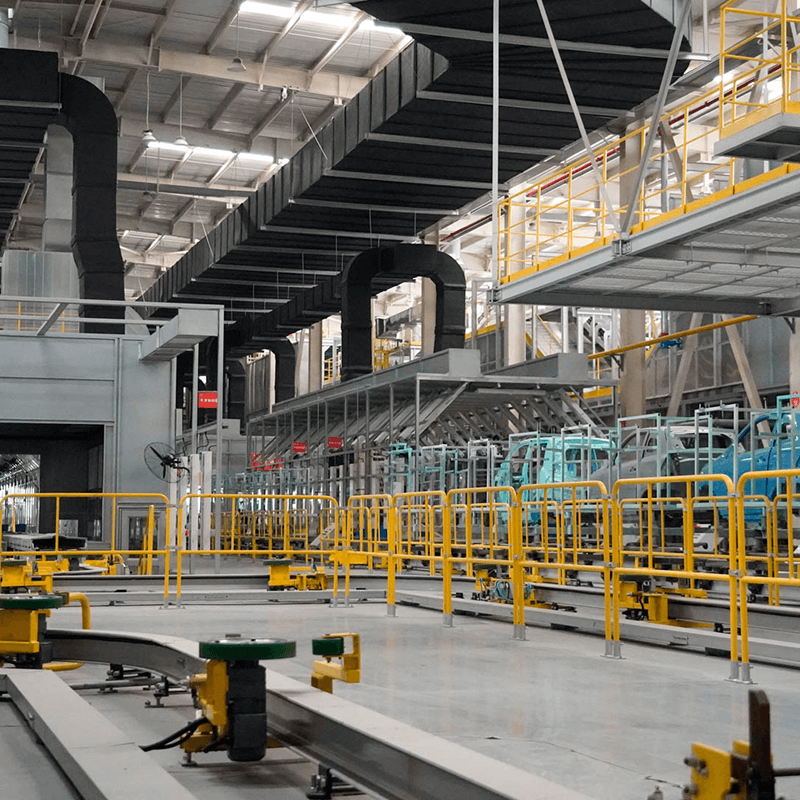
Moving parts smoothly through application zones requires robust material handling. You must match conveyor technology to your operational cadence.
Selecting the right material handling system ensures seamless routing. Standard overhead monorails provide continuous, fixed-speed movement. They handle lightweight, uniform parts easily and reliably. Power-and-Free conveyors offer unmatched routing flexibility. They utilize independent carriers riding on unpowered lower tracks. Mechanical dogs attached to an upper drive chain propel these carriers. This design allows carriers to stop, switch tracks, or buffer securely. It prevents catastrophic production pileups. Floor-mounted towline conveyors support excessively heavy loads safely. They work best for massive industrial machinery fabrication.
Upgrading from manual spray booths to multi-axis robotics ensures total film consistency. Automated arms optimize paint yield significantly. They utilize rotary atomizers to deliver precise fluid volumes. They eliminate human error during complex application sequences. This transition naturally requires sophisticated software programming. However, robotic integration drastically reduces raw material waste.
High-volume manufacturing demands extreme environmental precision. Standard industrial setups lack this rigorous control. An Automotive Painting Line necessitates advanced structural zoning. Facility engineers must install automated color-changing blocks on robotic arms. These purge lines rapidly between different vehicle batches. Furthermore, automotive applications operate strictly inside climate-controlled downdraft environments. These sophisticated enclosures manage humidity and temperature parameters tightly. Complete dust control becomes a paramount engineering concern in these setups. You must deploy multi-stage HEPA filtration to achieve a defect-free surface.
You cannot operate finishing equipment without strict regulatory adherence. Local municipalities monitor industrial emissions and chemical handling closely. Proactive engineering prevents costly production shutdowns.
Solvent-based Painting Line setups emit harmful volatile organic compounds (VOCs). You must manage these hazardous emissions aggressively. Regenerative Thermal Oxidizers (RTOs) destroy airborne pollutants effectively. These units incinerate exhaust gases at extreme temperatures before atmospheric release. Advanced dry filtration systems capture fine particulate matter inside the spray enclosure. Ignoring these crucial mitigation regulations invites severe legal penalties.
Pretreatment wash stages generate significant chemical runoff continually. Facilities must handle this industrial wastewater responsibly. Modern facilities increasingly implement Zero Liquid Discharge (ZLD) technologies. ZLD eliminates toxic effluent release entirely. Evaporators condense solid chemical waste for safe, dry disposal. Concurrently, the system recovers clean water for immediate process reuse. This closed-loop approach simplifies local environmental permitting significantly.
Fire mitigation remains mandatory across all finishing facilities. You must strictly adhere to NFPA or ATEX safety standards. Proper booth drafting prevents dangerous vapor accumulation near operators. Grounding all application equipment securely eliminates stray static sparks. Facility managers must install specialized chemical fire suppression systems. These measures safeguard your entire plant from catastrophic ignition events.
Facility integrators often overlook structural and operational challenges during the planning phase. You must anticipate these hurdles early to ensure continuous operational uptime.
Running high-temperature curing ovens consumes massive utility resources daily. Large-scale exhaust fans draw substantial electrical power continuously. You must analyze these long-term utility demands carefully before finalizing equipment sizing. Implementing air-to-air energy recovery systems mitigates this heavy consumption. Heat exchangers effectively capture wasted exhaust heat. They redirect this thermal energy to preheat incoming fresh air. This strategy optimizes operational efficiency significantly over the equipment lifespan.
Retrofitting massive machinery presents serious logistical hurdles. You cannot easily halt existing assembly processes during construction. Phased installations minimize operational disruptions effectively. Planners must schedule heavy structural work during weekend off-shifts. Installing overhead structural steel often requires reinforcing existing roof trusses. You must coordinate these civil engineering modifications far ahead of equipment delivery.
Engineers must design every zone for rapid, straightforward maintenance. If exhaust filters remain highly inaccessible, workers will simply neglect them. Ensure designers include ground-level, easy-access filter banks. Specify quick-disconnect, cleanable spray nozzles for the pretreatment tunnel. Guarantee safe catwalk access to elevated conveyor drives and oven burners. Prioritizing maintenance accessibility directly ensures continuous, reliable system uptime.
Choosing the right integration partner guarantees long-term success. You must vet vendors thoroughly based on proven engineering capabilities.
Demand custom 3D spatial modeling from every prospective vendor. Never accept generic, off-the-shelf, force-fit solutions. Elite manufacturers utilize point cloud scanning to map your existing facility precisely. Visualizing the layout in three dimensions prevents severe spatial conflicts during installation. It guarantees proper clearance for maintenance personnel.
Prioritize integrators offering comprehensive laboratory testing facilities. They should test your specific parts directly. They must validate the proposed chemical formulas on your actual substrates. Conducting cross-hatch adhesion and salt spray tests validates the process. Prototyping physical results before the actual build guarantees mechanical viability.
Evaluate vendors strictly on their post-installation commitments. Robust commissioning phases identify early mechanical flaws immediately. Insist on comprehensive operator training programs to ensure smooth facility handoffs. Guaranteed rapid spare parts availability prevents prolonged mechanical shutdowns. Review their service level agreements meticulously before signing any procurement contracts.
Designing a highly reliable finishing system requires balancing spatial constraints against rigorous throughput goals. You must seamlessly integrate complex pretreatment chemistry to ensure lasting durability. Strict environmental compliance and structural safety codes shape the final equipment architecture. We advise all stakeholders to conduct comprehensive facility audits immediately. Document your exact substrate dimensions and weight metrics carefully. Detail your daily throughput expectations clearly. Compile this technical data meticulously before issuing any formal requests for proposals to prospective equipment manufacturers.
A: Typical lead times range from six to twelve months. Initial engineering approvals and spatial modeling require several weeks. Custom equipment fabrication takes three to five months. On-site installation and final mechanical commissioning demand another four to eight weeks. Complex automated facilities often extend this timeline further.
A: We generally advise against it. Liquid and powder systems require vastly different application environments. Combining them introduces severe cross-contamination risks. Airborne powder easily ruins wet paint finishes. Practical engineering limitations strongly favor building parallel, dedicated systems for each specific coating method.
A: Power-and-Free conveyors offer the best performance for heavy applications. Standard I-beam overheads move continuously, making part accumulation impossible. Power-and-Free systems allow individual carriers to detach from the main drive chain. This enables variable routing, multi-speed processing, and secure staging of exceptionally heavy components.


