

close
Choose Your Site
Global
Social Media
Views: 0 Author: Site Editor Publish Time: 2026-01-22 Origin: Site


In modern manufacturing, selecting the right coating line is a strategic decision that directly affects product quality, production efficiency, environmental compliance, and long-term operating costs. Among the many surface finishing solutions available today, the electrophoretic coating line and the powder coating line are two of the most widely used and frequently compared systems. Understanding their technical principles, performance characteristics, and real-world application scenarios is essential for manufacturers aiming to build or upgrade an efficient coating line.
This article provides an in-depth, data-driven comparison of E-coating lines and powder coating lines, focusing on coating line differences, process workflows, cost structures, and industry trends. By aligning technical analysis with real Google user search intent, this guide helps decision-makers identify which coating line best fits their production goals.
A coating line is an integrated production system designed to apply a uniform, durable coating to parts or products through a series of controlled processes. Whether using liquid coatings, powder materials, or electrochemical deposition, every coating line is built around the same core objectives: consistency, efficiency, and scalability.
Among industrial coating systems, the electrophoretic coating line and the powder coating line represent two mature yet distinct technologies. While both are widely adopted in automotive, appliance, and industrial equipment manufacturing, their technical logic and application advantages differ significantly.
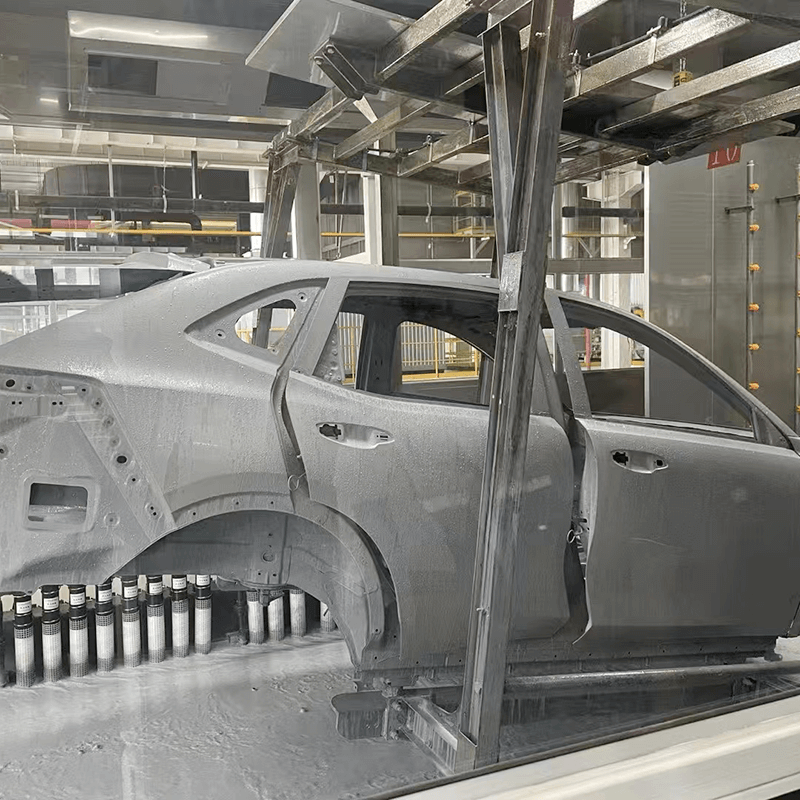
An electrophoretic coating line—often called an E-coating line—is a specialized coating line that uses an electric field to deposit coating material evenly onto conductive substrates. Parts are immersed in a coating bath, and electrical current causes paint particles to migrate and adhere uniformly to the surface.
Immersion-based coating process
Excellent coverage for complex geometries
High corrosion resistance
Precise control over film thickness
Typically used as a primer layer
In many automotive and auto parts factories, the electrophoretic coating line is considered the backbone of the entire coating line system due to its unmatched consistency and protection performance.
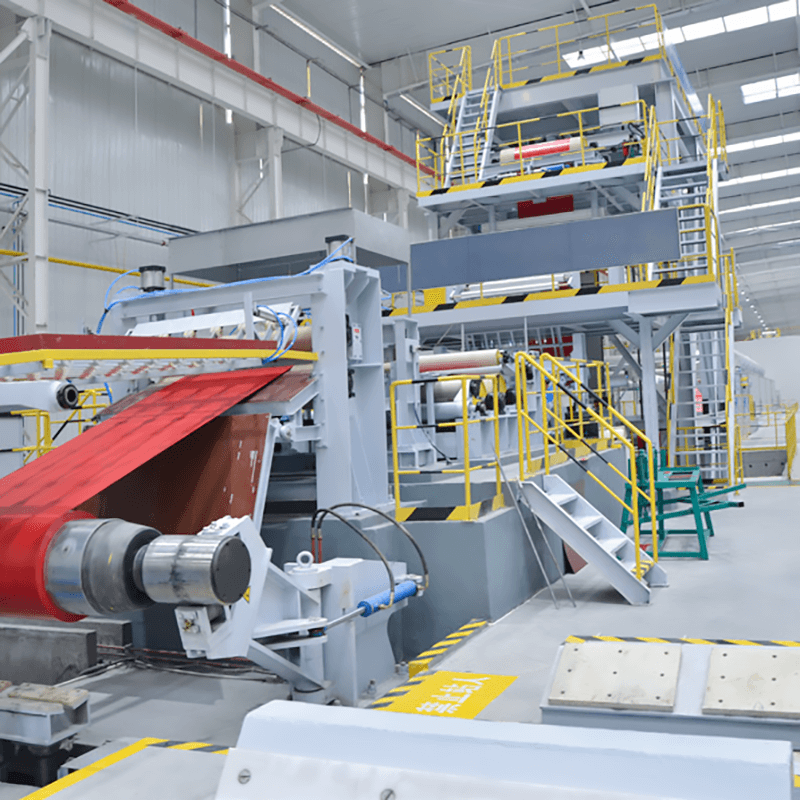
A powder coating line is a dry finishing coating line that applies powdered coating material electrostatically to the surface of parts. The coated parts are then cured in an oven, where the powder melts and forms a smooth, durable finish.
Dry, solvent-free coating process
High material utilization and recyclability
Excellent surface appearance
Wide color and texture options
Lower VOC emissions
The powder coating line is widely adopted as a final finishing coating line, especially in industries prioritizing appearance and environmental sustainability.
To fully understand coating line differences, it is essential to compare the process flow of an electrophoretic coating line and a powder coating line.
Pretreatment (degreasing, phosphating)
DI water rinsing
E-coating immersion tank
Ultrafiltration and rinsing
Baking and curing
Cooling and inspection
Pretreatment (chemical or mechanical)
Drying
Powder spraying
Powder recovery
Curing oven
Cooling and inspection
Both workflows are typical examples of modern coating line design, but the process logic clearly illustrates fundamental coating line differences.
The table below highlights the most critical coating line differences from a technical and operational perspective.
| Comparison Item | Electrophoretic Coating Line | Powder Coating Line |
|---|---|---|
| Coating method | Immersion + electric field | Electrostatic spraying |
| Film uniformity | Excellent, even on hidden areas | Very good on visible surfaces |
| Corrosion resistance | Outstanding | Good to excellent |
| Material utilization | High | Very high (recyclable powder) |
| Environmental impact | Low VOC | Zero VOC |
| Initial investment | Higher | Moderate |
| Operating complexity | High | Medium |
| Typical application | Primer coating | Decorative / functional topcoat |
This comparison shows that neither coating line is universally superior; instead, the optimal choice depends on product requirements and production strategy.
From a quality standpoint, the electrophoretic coating line excels in coverage and corrosion resistance, particularly for parts with complex internal structures. This makes it indispensable in automotive bodies and structural components.
In contrast, the powder coating line offers superior surface appearance and finish flexibility. Color consistency, texture options, and scratch resistance make it ideal for consumer-facing products.
These functional coating line differences explain why many manufacturers combine both systems into a complete coating line solution—using E-coating as a primer and powder coating as a topcoat.
Cost is a major factor when evaluating a coating line. While the electrophoretic coating line typically requires higher upfront investment due to tanks, ultrafiltration systems, and complex control units, it delivers long-term value through durability and reduced rework.
The powder coating line, on the other hand, is more cost-effective in terms of installation and maintenance, especially for medium-scale production.
| Cost Factor | Electrophoretic Coating Line | Powder Coating Line |
|---|---|---|
| Initial equipment cost | High | Medium |
| Maintenance cost | Medium to high | Low to medium |
| Material waste | Low | Very low |
| Energy consumption | Medium | Medium |
These figures highlight practical coating line differences that directly affect ROI calculations.
Modern manufacturing places strong emphasis on sustainability. Both the electrophoretic coating line and the powder coating line align well with environmental regulations, but in different ways.
The electrophoretic coating line minimizes paint loss and reduces VOC emissions through closed-loop systems.
The powder coating line eliminates solvents entirely, making it one of the most environmentally friendly coating line options available.
As regulations tighten globally, these eco-friendly characteristics significantly influence coating line selection.
Several trends are shaping how manufacturers compare and deploy coating line technologies:
Automation and robotics for consistent coating quality
Smart monitoring systems for real-time process control
Energy-efficient curing ovens
Integrated coating line solutions combining E-coating and powder coating
Suppliers with deep system integration experience—such as BONITA MACHINERY CO., LTD., whose technical roots date back to 1999—are increasingly delivering turnkey coating line solutions that seamlessly integrate electrophoretic and powder coating processes for automotive and industrial clients.
Choosing between an electrophoretic coating line and a powder coating line depends on application needs.
Corrosion resistance is critical
Parts have complex shapes or cavities
The coating serves as a primer layer
Appearance and color variety are priorities
Environmental compliance is a key concern
Production requires fast changeovers
In many cases, the most effective solution is not choosing one over the other, but designing a hybrid coating line that leverages the strengths of both technologies.
Integrating different coating technologies into one coating line can present challenges:
Process synchronization
Space constraints
Energy management
Operator training
Advanced coating line design and system integration expertise are essential to overcoming these challenges and ensuring long-term operational stability.
The main coating line differences lie in the coating method: immersion with electrical deposition versus electrostatic powder spraying.
Yes, many manufacturers integrate both into a single coating line for primer and topcoat applications.
Both are eco-friendly, but the powder coating line has zero VOC emissions.
It is more commonly used in large-scale production due to higher initial investment.
With proper maintenance, a high-quality coating line can operate efficiently for decades.
When comparing an electrophoretic coating line and a powder coating line, the key lies in understanding their technical strengths, cost implications, and application scenarios. These coating line differences are not obstacles but opportunities—allowing manufacturers to design smarter, more efficient surface finishing strategies.
By aligning product requirements with the right coating line technology, manufacturers can achieve superior quality, operational efficiency, and long-term competitiveness in an increasingly demanding global market.


