

close
Choose Your Site
Global
Social Media
Views: 0 Author: Site Editor Publish Time: 2026-08-31 Origin: Site


Stable output from an electrophoretic coating line is the result of disciplined process care, not emergency repair alone. The line combines wet chemistry, electrical equipment, filtration, pumps, racks, conveyors, rinse stages, and thermal curing. A small failure in one section can become a coating defect much later in the route, making the original cause difficult to recognize. Preventive maintenance should therefore combine mechanical inspection with routine verification of bath condition, rinse performance, power delivery, part handling, and oven operation. The goal is to find drift before it becomes scrap, rework, missed deliveries, or a costly shutdown.
A useful maintenance plan separates daily operating checks from periodic preventive tasks and condition-based interventions.
Bath circulation, filtration, UF equipment, rectifiers, anodes, racks, rinse nozzles, conveyors, and curing equipment all affect coating consistency.
Maintenance records should connect findings to process symptoms, such as defects, throughput changes, alarms, or energy use.
Safe access, lockout procedures, paint-supplier guidance, and the equipment manual should govern the exact work instructions and intervals.
The maintenance program should start with a process map. List every stage that can affect the part: loading and racking, pretreatment, water rinses, electrodeposition, ultrafiltration rinses, drain zones, oven cure, cooling, unloading, and inspection. For each stage, identify what must remain stable, how it will be checked, who owns the check, and what happens when the result is outside the validated limit.
This format distinguishes routine operation from maintenance. An operator may record a normal bath or oven trend during each shift; a maintenance technician may inspect a pump seal, conveyor drive, or electrical connection on a planned interval; a specialist may clean or service UF equipment according to its condition and supplier instructions. All three activities support reliability, but they require different skills and documentation.
Avoid the “run until it fails” approach for hidden components. A partially blocked nozzle, a deteriorating grounding contact, a drifting sensor, or a filter approaching its replacement condition may not stop the line immediately. It may instead appear as gradually higher paint use, a localized film defect, inconsistent coverage, or increasing rework. Early detection is less disruptive than a failure during a production run.
The e-coat bath is a process medium, not just a tank of liquid. Its operating condition is governed by the paint supplier’s requirements and the validated process plan. Typical control categories may include temperature, solids, pH, conductivity, contamination indicators, and circulation behavior, but the approved limits and test methods should never be guessed from a generic article. What matters is that the team uses one controlled method, reacts to trends, and records any adjustment.
Circulation keeps the bath mixed and helps maintain consistent conditions around immersed parts. Inspect pumps, strainers, filters, valves, seals, flow indications, and return paths according to the equipment plan. Look for leaks, abnormal noise, vibration, reduced flow, or unexpected pressure change. A pump can continue running while delivering insufficient circulation, so relying only on a motor-on indicator is not enough.
Filtration protects the finished surface from agglomerates and foreign particles. A filter change should be recorded with the observed condition, not simply ticked off. If a filter loads unusually quickly, the correct response is to investigate the source: incoming parts, paint handling, tank cleanliness, upstream contamination, or a process upset. Replacing filters without tracing the reason can allow the same contamination to return.
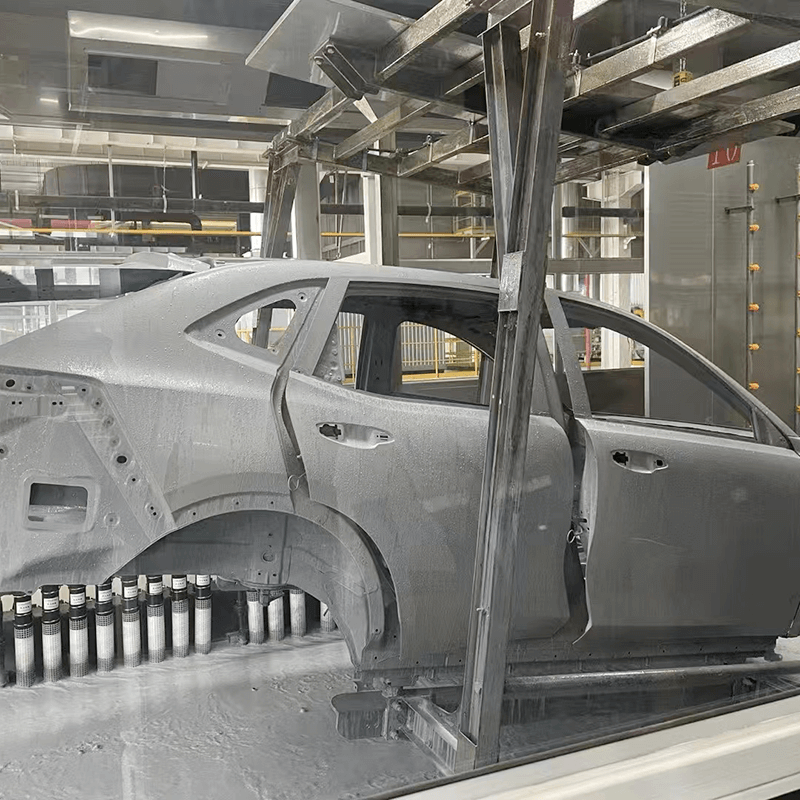
Ultrafiltration supports compatible rinsing and paint recovery after deposition. Its maintenance needs are directly tied to the selected paint system and the UF equipment documentation. Review membrane performance, pressure behavior, permeate quality, connections, cleaning routines, and any alarm history as required by the validated plan. Never use an unapproved cleaning method or chemical, because it can damage membranes or affect downstream coating behavior.
Rinse systems require attention to more than water supply. Inspect spray patterns, nozzles, filters, pumps, tank levels, overflow routes, return piping, and the parts’ drainage paths. A nozzle that is partly blocked can create a distinct defect zone; a damaged nozzle can disturb a newly deposited film; a poorly managed final rinse can leave residues before cure. Keep records of water-quality checks and abnormal drag-out so that changes in surface appearance can be connected to a real process signal.
An automated process such as BONITA MACHINERY’s automotive electrophoresis line benefits from a maintenance design that makes UF, rinse, and pump components accessible. Access is a reliability feature: if a team cannot inspect or clean a component without disrupting unrelated equipment, routine care is more likely to be delayed.
Electrical deposition depends on stable power delivery and reliable part contact. Rectifier checks should be performed by qualified personnel under the applicable safety procedures. Review output trends, alarm records, cooling condition, connections, and any signs of overheating or abnormal operation. The exact electrical tests, intervals, and acceptance values belong in the equipment documentation and the facility’s electrical-maintenance program.
Anodes and anode cells also need planned observation. Their condition affects the electrical field and bath balance, so leaks, fouling, damage, or abnormal behavior should be investigated before coating uniformity is affected. Do not turn anode maintenance into an afterthought simply because the parts still appear acceptable on exposed surfaces.
Racks, hooks, and grounding points deserve the same discipline. Remove accumulated coating where it compromises electrical contact, inspect fixtures for distortion or damage, and verify that the contact location remains repeatable. A poor rack contact can create thin or missing film that looks like a bath issue. Standardize rack refurbishment and record which fixtures are in service, especially for parts with deep recesses or tight coverage requirements.
Conveyor reliability affects dwell time, load spacing, safe handling, and the transition between wet and hot stages. Inspect lubrication points, drive components, tension, alignment, carriers, guards, and sensors according to the manufacturer’s requirements. An intermittent transfer issue can alter immersion time or cause a load to dwell unexpectedly in a rinse or drain zone; the coating symptom may appear far downstream.
Handling equipment should also preserve part orientation. A part that tilts differently after a hook wears can retain rinse water in a cavity, carry excess liquid into the oven, or show inconsistent coverage. Treat rack orientation and load spacing as controlled process settings, especially after maintenance work or a fixture change.
Curing equipment should be verified for the conditions required by the selected coating system. Monitor the oven’s temperature-control behavior, airflow, exhaust condition, door seals, sensors, and conveyor movement. A displayed setpoint is not by itself proof that every part reaches the intended cure condition. Establish a verification method appropriate to the process, document the result, and investigate changes in film hardness, adhesion, appearance, or energy use alongside oven data.
Frequency category | Typical purpose | Examples of planned activity |
|---|---|---|
Each shift or daily | Detect visible drift before producing more affected parts | Observe leaks, alarm status, spray coverage, rack contacts, bath and rinse trends, and abnormal conveyor behavior. |
Weekly or scheduled routine | Preserve mechanical and process readiness | Inspect filters and strainers, nozzles, pump behavior, fixture condition, selected conveyor components, and housekeeping around tanks. |
Periodic preventive service | Maintain components that can degrade without visible warning | Service drives, electrical panels, sensors, anode-related components, UF equipment, and oven systems following approved documentation. |
Condition-based action | Respond to evidence rather than calendar time alone | Investigate abnormal pressure, flow, temperature, conductivity trend, defects, vibration, alarms, or energy consumption. |
The table establishes categories rather than universal intervals. The actual schedule must reflect operating hours, paint chemistry, water quality, ambient conditions, part loading, equipment design, and local safety requirements. A busy production line may need a different interval from one operated intermittently.
A maintenance record is most valuable when it enables a decision. Record the component, finding, measurement if applicable, corrective action, person responsible, and the production impact. Link major observations to quality results: a new particle defect, a change in film thickness, an unusual rinse conductivity trend, or an oven alarm. Over time, this history helps distinguish an isolated event from a recurring failure pattern.
Spare-parts planning should follow the same logic. Identify components whose failure would stop production or materially affect coating quality, then define the approved spare, storage condition, and replacement procedure. Do not stock parts blindly; prioritize items with long lead times, high criticality, or evidence of wear. Verify that technicians can access the relevant documentation and understand the safe isolation steps before a breakdown occurs.
The existing BONITA MACHINERY article on maintenance for consistent electrophoretic coating can also be used as a related on-site resource. A site-specific maintenance program should remain aligned with the installed equipment manuals, the paint supplier’s instructions, and the facility’s safety management system.
Calendar-based tasks are essential, but many maintenance needs appear after a change in operating conditions. A new part with larger surface area can alter drag-out and pump demand. A different rack may change electrical contact quality. A production-rate increase can load filters and rinse stages more quickly. A seasonal water-quality shift may affect pretreatment and rinsing. These events should trigger a targeted review of the components and process checks most likely to be affected.
The same principle applies after corrective work. If a pump, sensor, rectifier component, nozzle manifold, or conveyor drive is replaced, verify that the work restored the intended process condition rather than only that the machine starts. Record the baseline result after maintenance and compare it with the next production trend. This closes the loop between mechanical reliability and coating quality, helping the team recognize whether an activity has stabilized production or has introduced a new variation.
Finally, make ownership visible. A checklist has little value if a technician assumes an operator has completed the check and the operator assumes maintenance will do it later. Define the responsible role, escalation path, and record location for each critical task. Clear ownership is what turns a maintenance schedule into reliable daily behavior.
Reliable maintenance of an Electrophoretic Coating Line connects the chemical, electrical, mechanical, and thermal parts of one process. Daily observations prevent drift from being ignored; preventive tasks protect pumps, filters, UF equipment, contacts, conveyors, and ovens; condition-based checks focus attention where the data shows risk. BONITA MACHINERY manufactures and supplies coating-line systems, but long-term stability depends on a documented, safe program that is validated for the installed equipment, paint chemistry, and actual production load.
There is no single task. Stable output depends on maintaining bath control, circulation, filtration, electrical delivery, rinses, racks, conveyors, and curing equipment as connected parts of one process.
Follow the membrane and coating-system documentation, supported by observed permeate performance, pressure behavior, alarms, and process results. A fixed generic interval may not suit every line.
Racks carry the electrical connection to the workpiece. Paint buildup, corrosion, wear, or damage can increase resistance and cause thin or missing film.
Yes. Transfer interruptions or speed variation can change immersion, rinse, drainage, or cure conditions. Worn carriers can also change part orientation and spacing.
Keep component findings, relevant measurements, actions taken, alarm history, parts replaced, and links to any quality or production effect. These records support troubleshooting and recurring-failure prevention.


